2007-07-10

Astronomy Bloggers and Twitter

It's two months now since I created a Twitter account and made my first post (mainly because of Stuart's rather neat back). Since then I've been trying to hunt down astronomy bloggers and astronomy related people/things on Twitter and adding them to my watch list.

Here's who/what I've got so far:

Anyone got any others? Am I missing a handy little source of instant updates?

2007-07-09

Number 10 Responds

The office of the Prime Minister has given a response to a recent petition regarding light pollution.

I've had a quick scan of the response and, at the moment, I'm unsure if it's a good thing, bad thing or somewhere in the middle. I should probably take a careful look at the content of the response and compare it with the information I can find on the CfDS website.

At the Zoo

I'm registered at the Zoo, how about you?

2007-07-05

Fancy a Trip to the Zoo?

According to Chris Lintott Galaxy Zoo will be going live in less than a week.

It sounds like a pretty interesting idea:

Welcome to GalaxyZoo, the project which harnesses the power of the internet - and your brain - to classify a million galaxies. By taking part, you'll not only be contributing to scientific research, but you'll view parts of the Universe that literally no-one has ever seen before and get a sense of the glorious diversity of galaxies that pepper the sky.
I'm looking forward to seeing how it all works.

2007-06-16

Daylight Occultation of Venus

Next Monday there will be a daylight occultation of Venus by the Moon. Details of the event can be found over on the SPA website.

I hope to try and observe this. Having managed to observe the recent occultation of Saturn I'd love to have another occultation in my observing logs.

However, I foresee two problems with this. The first is that, being a daylight occultation, I'll still be working. I can probably take some time off but I can never be sure if something is going to crop up. The other problem is the weather. According the the Met Office Monday, around here, is going to be cloudy, probably with rain.

For those of you who won't be able to observe this, either due to work, weather or just simply being on the wrong part of the planet: Peter Grego is planning a live webcast of the event if he's lucky enough to have clear skies.

2007-06-06

Blame it on the Moon

According to an article on the BBC website:

Extra police officers are to patrol the streets of Brighton on nights when there is a full moon.
This is going to happen after
Insp Andy Parr ... compared crime statistics for Brighton and Hove with lunar graphs to discover the trend.
and, apparently, he thinks he's found one.

It'd be interesting to see what he actually found, especially given that there seems to be a lack of evidence of any real correlation.

From my point of view it's tempting to imagine that more people will hit the streets when the Moon is full thanks to the extra light. And, of course, more people, especially if it's more people with a few drinks inside them, could cause an increase in incidents. But, if that's the case, wouldn't it make more sense to increase policing during many of the weeks around the summer solstice when, in most of the UK anyway, it never really gets that dark anyway?

I do like this bit though (emphasis is mine):
It follows research by the Sussex force which concluded there was a rise in violent incidents when the moon was full - and also on paydays.

2007-06-04

BBC Britain in Pictures

The BBC are currently collecting photographs via a Flickr group for a gallery as part of their How We Built Britain series.

I've submitted a few photographs and have also been enjoying looking at what others have been submitting. However, one thing struck me. There seem to be very few photographs of buildings related to astronomy. I've submitted one of the 36 Inch Telescope at the Institute of Astronomy in Cambridge, and I notice that Tim has submitted one of the Royal Observatory in Edinburgh.

Other than that I've not noticed any others relating to astronomy (it could be that I've just not found them yet).

Anyone out there on Flickr who has images of British buildings that relate to astronomy? Fancy adding to the gallery?

2007-05-30

What keeps the Moon in space?

Over the weekend my 5 year old son asked one of those questions that are so difficult to answer because the question itself is wrong, but also very endearing too. He wanted to know what kept the Moon "in space".

I tried my best to answer the question, but no amount of trying to point out that the question didn't really make sense (in a nice way) made a dent.

Well, this morning, I found the answer.

2007-05-24

Daylight meeting of the Moon and Regulus

Pete Lawrence does it again. This time he observed and photographed a daylight conjunction of the Moon and Regulus.

I'm impressed by and somewhat surprised at the ease with which he managed to find Regulus:

When first looking for Regulus, I was expecting something of a challenge to be able to pick it out. The Moon was the key to the observation because it provided a target to focus on and a reference point in an otherwise featureless blue sky.

As it turned out, Regulus actually appeared quite bright and intense. Using an Astronomik red filter darkened the sky (removed the blue component) and improved the view considerably.
I'm annoyed that I missed this.

2007-05-22

Lunar Occultation of Saturn

Tonight I was lucky enough to observe the lunar occultation of Saturn.

Skies were nice and clear for me when I got the Explorer 130M out at around 18:45 UT. By 18:51 UT (yes, no time to let the 'scope cool down) I had Saturn in the eyepiece. This in itself was a first for me. The Sun was still above the horizon — that's the first time I've observed that planet during the day.

The view kept switching from being very hard to make out to being very clear, sometimes clear enough that I could just about make out the planet's shadow on the rings.

The dark limb of the Moon wasn't visible at all so I had no visual clues as to how long I had to wait. There were a couple of false starts where I thought I could see part of Saturn was missing. And then, suddenly, it was really obvious that the Moon was cutting into the rings.

Sadly I didn't have a stopwatch with me so I had no way of timing how long the event took. It felt like it was over in about 30 seconds. I know I was very surprised at how quickly it all happened. It was all over by 19:06 UT.

And then I had a break. I had about an hour to wait until Saturn emerged.

Fast forward to 20:00 UT and the Moon was lost behind a load of cloud. I could see, towards the western horizon, a gap, but I didn't hold out much hope for it getting into place in time. For a while all I had to look at was:

Waiting for the Moon and Saturn
Click for larger picture

Finally, at around 20:12 UT a gap in the clouds gave me a view of the Moon but, just as quickly, it went again. By 20:13 UT a bigger gap moved into place and, through the 130M, I could already see Saturn. Part of the rings was still behind the Moon and over the next couple or so minutes I watched it fully emerge (Saturn was free of the Moon by 20:14 UT).

I just watched the gap between them widen for the next couple of minutes and, then, in a moment of madness (not the first moment of madness like this), I grabbed my mobile phone and held the camera in it up to the lens of the 'scope. This is what I got:

Moon and Saturn on Mobile Phone
Click for larger picture

Probably the worst occultation picture you'll see over the next few days. Probably the worst occultation picture you've ever seen and will ever see. But, what the hell, it had to be done. :-)

By 20:19 UT it had clouded over again. I left it a short while longer and then, realising that was it, I packed up.

I'm so glad I didn't miss it.

2007-05-21

Moon and Venus Crazy

It seems that lots of people either observed or photographed the Moon along with Venus. Amongst the astronomy blogs I read Ian got a shot despite the clouds, Nick got a shot (along with a shots of an Iridium flare and a pair of sun dogs) and Tim got a couple of images (including one exposed for the Moon's highlights and one exposed for the earthshine).

After doing a search on Flickr it seems that lots of people had a go at photographing this conjunction. The most unusual one I've seen is this one.

Jodrell Bank Featured on Twitter

Congratulations to Jodrell Bank! It seems their twitter page is a featured page over at twitter:


Seems there's a few astronomy related people and things on twitter now (in no particular order):
And, of course, I had to join in too.

And Mercury Too...

I really should prepare myself better before I go out observing.

Paul S, over on the SPA BB, pointed out that I should have captured Mercury along with the Moon and Venus. This is where I should have been prepared, I hadn't even realised that Mercury was visible around that time from that location.

I fired up Starry Night and had a look at where Mercury was and then went back and looked at the photographs I took and, sure enough, in just the right spot, there was faint little Mercury.

Of course, in the photograph I posted yesterday, my unprepared head was occulting the planet.

Have a look at this image. It's a blown-up crop of this:

Venus and Moon
Click image for larger picture

If you look carefully in the bottom right hand corner you'll be able to see Mercury.

So, on Saturday night, not only did I photograph a conjunction, I also managed to photograph an occultation of Mercury too. ;-)

2007-05-20

Venus, Selene and Me

I had a pretty late observing session last night, out with a couple of friends just enjoying the available sights (sadly cloud stopped play in the end).

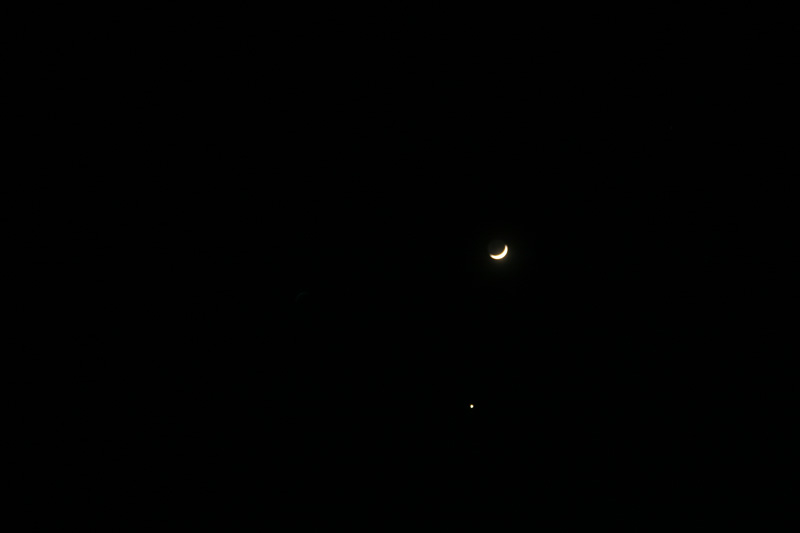
Almost right up until the point where we packed up (around 00:00 UT) the sky had one obvious and striking sight that you just had to keep going back and just looking at. For me nothing quite matches a crescent Moon and Venus. I'm not one for doing much in the way of astrophotography but I had to catch that sight. Not having the gear to do a good close-up (this is the best I could manage) I opted for a landscape shot instead. Actually, more of a landscape and self-portrait:

Venus, Selene and Me
Click image for larger picture

The log of that session should be up in the next day or so.

EDIT: The log is now up.

2007-05-17

A little bit of boasting

I received a copy of the June edition of Astronomy Now in the post yesterday. This one's a little extra special for me. In it there's an article about the 2007 SPA Convention and the two photographs that illustrate the event were taken by..... me! :-)

Yeah, yeah, I know, no big deal. But, as someone who enjoys photography as much as he does astronomy, there's something nice about seeing a "Image: Dave Pearson" accompanying a photograph in a magazine. Especially an astronomy magazine.

Okay, that's enough boasting now. I'll try not to let it happen again...

2007-05-15

In Praise of Clouds

Astronomers hate clouds.

Well, mostly. We generally like clouds on other planets. We sometimes like clouds on our own planet too. But, most of the time, we hate clouds. They get in the way of observing.

But you knew that.

Despite the fact that the weather's been pretty awful lately it's been putting on a pretty good show for me. In the last few days I've seen a nice stormy looking evening and, last night, a very dramatic sunset (which inspired this Hockneyesque montage — sorry about that, I've got a thing about creating montages).

So, the next time you can't observe because it's going to be cloudy, appreciate the clouds.

2007-05-09

Time to move on

When I read this item on the BBC yesterday I guessed it would be all over the astronomy blogs pretty soon although, at the time, I couldn't really see much point in commenting myself. However...

I think the worst aspect of it is that Chris felt the need to go on record and distance himself from the comments (he says "almost all", I'm guessing he agrees with the part that there's a lot of crap on British TV these days but that he disagrees with the posited cause — I'd agree with that too). I'm hoping that there's nobody out there who is stupid enough to think that the bizarre opinions of someone with a history of this sort of thing represent the opinions of everyone involved with a specific TV programme.

Leaving aside Moore's unpalatable opinions and past political aspirations, I do wish he'd retire and hand the rains over to someone like Chris. I'd love to see The Sky at Night fully handed over to some new blood (but please, please, hand it over to someone who is picked for their knowledge of and history in the subject — please don't hand it over to someone because of their celebrity status) and given a regular slot at a reasonable hour. Astronomy, as a hobby and an interest, deserves good publicity and, in the UK at least, probably needs a bit of an overhaul in terms of the perceived stereotype (part of which comes from people such as Moore).

That said, I do wonder if such thoughts are a waste of time, especially given some of the comments made by my fellow members of the SPA.

And then we wonder why there's a stereotype of amateur astronomy based around sad old men with nothing better to do with their time...

2007-05-08

I'm the Gnomon

I spent last weekend in Lancaster. While I was there I took a walk into Williamson Park so I could go and take some photographs of a pretty neat sundial they've got there.

When someone mentions "sundial" most people probably think of the more "traditional" kind of sundial that has a fixed gnomon. The Lancaster Sundial is a little different in that it's an analemmatic sundial and you play the part of the gnomon.


In the middle of the dial is an analemma. To tell the time, and to take the equation of time into account, you pick a spot to stand on depending on the date and then use your shadow to figure out the time (adding an hour if needed depending on daylight saving time).

You can see more images of the sundial in my album of photographs of Lancaster.

2007-05-02

AA 10953 on 2007-05-02

Yet another shot of my view of the sunspot in active area 10953:


As with yesterday I was also able to see the spot with the naked eye via eclipse shades.

2007-05-01

AA 10953 on 2007-05-01

The sunspot in active area 10953 continues to impress after a long period of viewing a blank Sun:


As with yesterday I was also able to see the spot with the naked eye via eclipse shades.

That's great, it starts with an earthquake...

It's been a while since I've seen a "scientists to bring the Universe to an end" story, but a fellow admin on the SPA BB made a post pointing at this vote on the BBC.

Come on, everyone sing along...

2007-04-30

AA 10953 on 2007-04-30

Another shot of the sunspot in active area 10953, taken earlier on today:


I also noticed today that the spot is visible to the naked eye (using eclipse shades, of course).

Flight to the Virgo Cluster

Via this post on the SPA BB: A flight to the Virgo Cluster:

AA 10953 on 2007-04-28

I managed to observe the Sun both days of this last weekend. The spot in active area 10953 continues to look pretty impressive (well, impressive by "we've not had much to look at for a while" standards). I didn't take a photograph on Sunday because conditions were far from ideal but I managed to get this shot on Saturday:

2007-04-27

Randomness

I just had a rather silly idea, and it took no time to implement.

I was thinking that I've got a lot of observing logs now and, to a large degree, I can generally find the one I want (often via the log index). But it might also be fun to have a facility that selects a random logs.

So that's what I did: view a random observing log.

Finally!

During the past couple of months I've had a pretty good run of clear days that have permitted lots of sunspot counts. However, the last time I actually saw a sunspot was 2007-03-03.

That finally changed today:

2007-04-23

Astroblast 2007 - Photographs

I made it to Astroblast and had a really good day out. I don't really have time to write about it at the moment (although I do hope to some time soon) but, meanwhile, here's a gallery of photographs I took while there.

You wouldn't believe the trouble I had to go to to smuggle them out of the event.

2007-04-20

Astroblast 2007

Tomorrow is Astroblast 2007. All being well I'll be going along again.

Looking at the website it appears that it'll be pretty much the same sort of thing as last year which, from my point of view (father with small child), isn't necessarily a bad thing.

Personally I found last year's effort to be quite enjoyable. I read a few negative reviews and most of the complaints seemed to revolve around the issue of it being "a bit lightweight" or "too aimed at children" — which I thought was kind of odd given that it seemed pretty obvious from the website that it was very much aimed at being a family day out with a particular emphasis on children. As someone interested in astronomy, who has a child and a wife who isn't that interested, it's nice to be able to go along to something relating to astronomy with my family and without them being bored stupid (let's be honest, the "hardcore" events have nothing of interest if you're not deeply interested in the subject).

The only complaint that made real sense was about the lack of catering facilities. As I understand it, this year, this won't be a problem (or so I was told by someone on the Greenwitch stand at this year's SPA convention). It's odd, though, that they don't seem to mention this on the Astroblast website.

2007-04-18

The ISS, Leo and Saturn

Tonight I had my first go at photographing the International Space Station.

Earlier in the day I saw on Heavens Above that there would be a good pass this evening so I decided to have a go at photographing it. I went out with about 15 minutes to spare and set the Canon EOS 400D up on the tripod and did a few test shots. I had a hell of a time trying to get it focused well but managed to get close to something useful before it was time.

Just as the ISS approached I realised that I had the shutter speed set to 30 seconds rather than bulb and that I'd not yet used the remote in bulb mode and wasn't exactly sure how it worked so, rather than miss the pass, I just went for the 30 second exposure. This is the result:

International Space Station
Click on the picture for a bigger version

That's the jpeg straight off the camera, just with a slight crop, a tweak of the levels and a resize before uploading to my Flickr account.

It's not perfect, but as a first attempt I'm pretty pleased.

Growing up in the Universe

Not exactly astronomy, I know, but I'd imagine that most people reading this will be interested in the following, for more than one reason.

Richard Dawkins' 1991 Royal Institution Christmas Lecture will soon be available to buy on DVD. Earlier on this month a short advert was made available.

Now there's a short excerpt available, and (for me anyway) it's made all the more special because of who appears in it.


I am so going to be buying a copy!

2007-04-04

Saturn and a mobile phone

Sorry about this, but this is yet another one of those "look what I imaged with my mobile phone" posts. I know it's not big, I know it's not clever, but, but, because I can....

This evening I was out observing Venus for a while and then, when Venus got low, I turned to Saturn. What a view! One of the best I've ever had. And, as I have a horrible habit of doing, in a moment of madness I decided to see what I could capture with the mobile phone. This is what I got:


Okay, Damian Peach it isn't, but you can at least tell which planet it is.

2007-04-03

Accidental stereogram

Not exactly astronomy, but it does relate to one of my telescopes...

Over the weekend I was taking some new photographs of my two 'scopes to replace those on the tools page of my site (the ones that had been there had been taken with mobile phones and were of terrible quality). While reviewing the shots yesterday I noticed that two of them appeared to be taken from almost exactly the same spot and at exactly the same height.

In other words, I appeared to have accidentally created a stereogram. I then placed them side by side in one image and got this result:

Sky-Watcher Explorer 130M Stereogram

If you're the sort of person who can go cross-eyed without any trouble you should be able to see the 3D effect. Click on the image for a bigger version.

Newton from space

The most recent Google Maps update has seen the addition of lots of new high resolution images for Lincolnshire. Not only have the areas that already had hi-res images been updated, lots of new areas have been added.

So, I was having a look around and seeing what I could see and I noticed that, finally, Woolsthorpe-by-Colsterworth was covered. Because of this it's now finally possible to get a good view of Woolsthorpe Manor. The manor itself is the building in the top left corner of the cluster. If you look carefully in the small field to the left of the cluster of buildings you'll see some of the (in)famous apple trees.

Newton himself is also now visible thanks to this new update. Well, okay, not Newton himself, but if you look carefully you can see the shadow of his statue in Grantham.

Venus

As I noted a few days back, I've finally been observing Venus via a telescope (to the best of my knowledge this year is the first time I've ever done that). The log from the first session can be found here, the second session was a couple of days later.

Two things stand out so far. The first is that these sessions are probably the first time I've noticed filtering making a big difference to a visual image. I've found that, on the 905, a combination of the contrast booster and a 80A medium blue work really well.

The second thing I've noticed is just how tricky a target Venus is. While it's obvious that I've been observing something that has a gibbous phase I've been struck by how indistinct the view is. Of course, this won't be helped by the fact that I'm observing Venus when it's quite low to the horizon – lower than I'd generally observe other planets. It's probably also not helped by the fact that I'm not really using the best 'scope for the job.

But! Will Gater comes to the rescue. His great picture of Venus reminds me an awful lot of the view I've been having of Venus (albeit my view is obviously somewhat smaller than that). It's always nice to have something to compare to and that image really helps.

2007-04-02

A quiet month on the Sun

Going on my records, and keeping in mind the limitations of my equipment, March was a very quiet month for visible solar activity. I managed 20 sunspot counts last month and only saw a sunspot for the first two days of the count. From what I can tell that's the least active month I've observed since I decided to do regular counts starting March last year.

2007-03-29

Close approach of asteroid

Seen over on the BBA website:

Asteroid 2006 VV2 passes close to the Earth at the end of March and the early part of April. At its closest, on March 31, it will be 0.0226 AU away (8.8 lunar distances). This will be the closest known approach by an object this intrinsically bright until May 2036, when binary asteroid (66391) 1999 KW4 (H=16.4) approaches within 6 lunar distances. Observers should be able to see it through modest telescopes as it reaches 10th magnitude on March 31st and April 1st.
That sounds worth keeping in mind and having a hunt for if I'm out and observing at the right sort of time.

Fun Flickr Sunsets

I recently started having a play around with Flickr (and I'm mostly impressed by it; it is a little easier than maintaining my own photo gallery) so when I saw this story on Astronomy Blog this morning it really caught my attention.

How cool is that?

I just love it when the "obvious" is found in "not so obvious" places.

2007-03-26

Venus at Sunset

There was a really nice looking sunset yesterday evening, just a touch of mist, really nice subtle colours in the sky. I just had to grab the camera and head out to the edge of the village and run off a few pictures.

While they don't quite qualify as astrophotography I did make a point of including Venus in some of the shots.

Even better, when I got back home, I noticed that Venus was still visible from my back garden. I immediately got the Antares 905 out and had a session observing the planet. I think this is the first time I've ever observed Venus through a telescope. It's definitely the first time I've observed it via a 'scope since I got back into observing.

2007-03-22

Moon and Venus

I was lucky enough to have some clear skies last night so I went out with the EOS 400D and a tripod and took some photographs of the Moon and Venus together.

As it was they didn't turn out that well, I really need to work on getting the focus right.

I notice that Ian also took some images and also did an animation too. Although, as always, he seems to have managed to photograph everything upside down. ;)

2007-03-20

Star Cards

Last Saturday I was up in York, visiting family. While up there we took a trip to the Castle Museum. There wasn't an awful lot there related to astronomy (there was a display case full of instruments made by T. Cooke & Sons — which included a really nice brass achromatic telescope) but, in the display of children's toys, I did find these rather nice "Star Cards":


Sadly I couldn't see any information about them. I'd love to know who made them and what the story was (and how many there were in a set).

They reminded me of the time when, as a child, I made my own set of constellation cards.

2007-03-15

BAA/CfDS/CPRE star count results

The BAA website now has the results of the December and January star count.

Nearly 2,000 people took part in the star count. Only 2% of people who responded to our online survey said they could see more than 30 stars, compared to 54% who saw fewer than 10 stars in Orion – a level which indicates severe light pollution.
Have a look at the article for a full breakdown of the results (there's also a map of the results too).

Also, don't forget the GLOBE count. I've not had the chance to have a go yet, but time and weather permitting I'm planning on it.

2007-03-12

SPA Convention 2007 - A Short Report

It's been almost a year and a half of waiting but, finally, last Saturday arrived and it was time for the second Society for Popular Astronomy convention.

The day was laid out similar to that of the first convention with various talks during the day, the main talk being The Planet Venus and the Venus Express Mission by Professor Fred Taylor. Alongside all the talks were various stands by the sections of the SPA and also various stalls hosted by a number of vendors of items relating to astronomy.

The doors opened around 09:30 and the main reception area seemed to fill up very quickly – for a short while there was even a queue to get in. Around 10:00, after people had had a chance to get in, get a drink (drink and food was available for sale all day) and have a look around some of the displays and stalls, the bell was rung and people filed into the lecture theatre to hear Dr Ian Crawford deliver the welcome and then hand over to Nik Szymanek for the first talk of the day.

The talk was mostly for beginners and provided plenty of information on how to get started photographing the night sky. Nik also went on to relate some of his experiences photographing from the top of La Palma while showing us some of the results acquired during such trips (including some excellent images of daytime atmospheric phenomena).

A tea break followed and I joined a guided tour of the Thorrowgood and Northumberland telescopes. The Thorrowgood telescope had been set up to track and project the Sun (and, as you'd expect, this happened to be a day with no sunspots visible) while the Northumberland had been set up to track Venus. Sadly, during the tour I was on (there were many such tours available during the day), there was just enough cloud cover to make such an observation impossible.

When I got back from the tour it was time for Nik's second talk of the day, this time an interactive question and answer session dealing with all aspects of astronomical imaging. Given that I'm not that interested in imaging at the moment I decided to skip this and, instead, have a wander around the stalls. I had a chat with Greenwitch — mostly about last year's and this year's Astroblast (the good news is that this time round there will be catering!) – and I also had a good look around the stall run by Astronomica (while there I picked up an affordable 2x barlow to replace the rather terrible one that came with my Explorer 130M – I'm hoping it should do a better job and I'll report on that when I get the chance to try it out).

The next talk was in two parts, the first was about the Terran Planets and was delivered by Michael Hezzlewood; the second part was about observing Saturn and was delivered by Ian Phelps. The talks were slightly delayed due to problems with the projection system and part of the talk was slightly marred by the lack of a microphone (leading to the occasional shout of "speak up!" from the back of the room). Despite the technical problems both parts of the talk turned out to be interesting and informative.

After that talk I spent some time wandering around some more before having lunch. Around this time it was pointed out to me that Martin Rees was wandering around (given that we'd taken over his place of work for the day I guess it was no surprise) and he was kind enough to pose for some photographs.

Finally it was time for the main event: Professor Fred Taylor's talk about Venus and the Venus Express mission. It was great to see that the talk itself had been over-subscribed and that the lecture hall was packed out (despite having a ticket I ended up sitting on the floor at the front, although that was because I'd been helping out checking tickets on the door).

Professor Taylor started out with a background of Venus, paying particular attention to those questions that Venus Express was designed to answer. I found this pretty fascinating given that I thought I knew pretty much everything there was to know about Venus (at least, things that would be interesting to and understandable by an amateur with a layman's interest). I was particularly fascinated to learn about the Venus Polar dipole.

Professor Taylor then went on to explain some of the background and design of Venus Express, following up with an explanation of what it would be doing for the duration of the mission and also telling us about some of the results that have been acquired so far. He then finished off with a really fascinating sequence of slides that illustrated a visual connection he'd made between the latest images of the polar dipole and the Lorenz attractor.

Another tea break followed and after that was a quick talk about Comet McNaught followed by a talk entitled Instruments for Planetary Observing. I skipped these while I took the opportunity to have another look around the various stands (and to also start helping with a bit of tidying up). The day then finished off with the raffle (I didn't win anything, Paul Sutherland, on the other hand, managed to win twice – grrrrr!).

In conclusion, from my point of view, the day was an incredible success. I spoke to many people during the day and every one of them said they they were really enjoying themselves – this included people who weren't members of the SPA (but, fingers crossed, will be some time soon). I really enjoyed it. The talks were interesting, entertaining and informative. The atmosphere of the whole day was friendly and welcoming. It was great to meet up with various names from the SPA again. It also felt like it was all over far too quickly.

It now looks like the convention will be held every other year and the next one, in 2009, promises to be extra special.

I can't wait.

SPA Convention Photographs

I've not had the chance to write up a report of the SPA convention just yet. I have, however, uploaded my photographs of the day.

2007-03-11

How wide is your hand?

Most people who have an interest in astronomy (or atmospheric phenomena) will know the usual tricks for measuring angles and distances in the sky. The general idea is that you hold your hand at arm's length and, using difference parts of your hand, held in different ways, get a reasonable measure.

But how accurate is this approach?

Robin Scagell, via a post on the SPA BB, aims to find out:

I would like to find out what is the average dimension of a hand span in degrees. It is often said that a full hand span at arm's length is 20°, but I would like to get some accurate figures on this. So I have checked the distances between several well-known stars in the early evening sky and would like people to go out and test it for themselves.
Have a look Robin's post for full details of the experiment.

2007-03-09

SPA Convention 2007

It's almost here! One more day and it's the SPA convention 2007.

I'll be heading out to Cambridge rather early tomorrow morning (about 0600UT) as I'm going to lend a hand setting things up. As such it should be a long, but enjoyable, day.

The main themes for this year's event are astrophotography and planetary astronomy and talks include:

  • Pixel Magic - Getting the best from your Astro Photography

  • Saturn and the Terran Planets

  • Venus and the Venus Express Mission

  • Instruments for Planetary Observing
There's also going to be a few trade stands there if there's money burning a hole in your pocket (I'm pleased to see that Aurora Books will be there — I know Martin from the days when I was a member of York Astronomical Society and it's always nice to catch up).

If you're going to be there do keep an eye out for me and tap me on the shoulder and say hello. I'll probably be wearing a name badge and, if it helps, the picture of me chimping over on my photo.net page should give you a bit of a clue about how I look these days (chances are that I'll be chimping away there too <g>).

2007-03-08

Pluto is a Planet (Says New Mexico)

Seems that the state legislature of New Mexico has decided that Pluto is a planet.

Apparently March 13th 2007 (only 2007?) will also be "Pluto Planet Day".

2007-03-07

Not Just Red - Infrared!

Once again Pete Lawrence comes up with an interesting spin on astrophotography. Via this article on the SPA BB:

The eclipsed Moon was quite dim in visible light but reasonably bright in IR. I managed to grab 4 quadrant shots of the Moon at the time of totality, mosaic them together and then overlay a DSLR colour shot on to. In this way the IR provides the luminance information while the DSLR shot provides colour. The result is an IR biased colour shot of totality. As the IR signal was reasonably bright, the details on the Moon could be imaged with a reasonable amount of sharpness.

2007-03-03_23-28-20_IR742-natural.jpg

World-Wide Star Hunt

Back in December last year I reported on the BAA/CfDS/CPRE star count. Stuart picked up on this and, in the comments on Stuart's blog, Ian sort of got to thinking about an international effort to do something similar.

This morning I had an email from Robin Scagell, alerting me to Globe at Night. Here's an excerpt from the press release:

The international star-counting activity known as GLOBE at Night returns from March 8-21 in two flavors: the "classic" GLOBE at Night exercise that anyone can have fun doing with their unaided eyes, and a new effort to obtain precise measurements of urban dark skies using digital sky-brightness meters.

The GLOBE at Night 2007 program is intended to build upon the worldwide participation sparked by the first GLOBE at Night campaign in March 2006. This inaugural effort drew more than 18,000 citizen-scientist participants in all 50 U.S. states and 96 countries worldwide, who submitted nearly 4,600 observations of the darkness of their local night skies during the 10-day event. The program is designed to aid teaching about the impact of artificial lighting on local environments, and the ongoing loss of a dark night sky as a natural resource for much of the world's population.
It seems they're also using Orion as the patch of sky for doing comparisons and, helpfully, they have a set of magnitude charts to help in estimations (and don't you just love the fact that they've produced just such a chart from a cloudy night).

There's even a nifty little tool for testing your estimation ability.

This all sounds like just the sort of thing that Ian will like.

Lunar Eclipse Movie

Tim Haynes (friend and BOFH for the machine I host my websites on) was also out on Saturday night, observing and photographing the total lunar eclipse.

Not only did he take a whole load of images of the event, he also produced a pretty neat video of it too:


It's a shame that the Moon has got squashed in the YouTube version (the original looks better) but, that aside, I think it's a pretty neat record of the event.

2007-03-06

What the hell is happening?

After reading this entry on Rich Daley's blog I was reminded of something I was thinking about on Saturday night.

What do people who have no knowledge or interest in astronomy make of something like a total lunar eclipse? Here in the UK you'd be hard pushed to find someone who didn't know that a total solar eclipse was coming, it's such a rare occurrence that it would be reported everywhere for days prior to the event (as it was in 1999). Most partial solar eclipses won't be noticed, most people who haven't been told about it won't know it's happening.

Partial lunar eclipses probably aren't noticed either, I'm guessing that most people, even if they noticed that part of the Moon was missing, would assume it's just one of the Moon's phases (it's not uncommon for people to think that the Earth's shadow is responsible for the Moon's phases).

But a total lunar eclipse seems a little different to me. It's one of those events that can be reported in such a way that people don't know it's happening (personally I only ever saw mention of Saturday's eclipse, in passing, during weather reports on the BBC news) while, at the same time, is very obvious to the naked eye – if you were out and about on Saturday night you'd be hard pushed not to notice that the Moon was full but wasn't bright and was a very strange colour.

I wonder what Rich's bouncer was really thinking. I wonder what ideas had gone through his mind. I wonder what possible reasons he'd entertained. I wonder how many other people were in the same position last Saturday, faced with something out of the ordinary, something impossible to ignore, something needing an explanation. I wonder what hypotheses they entertained.

2007-03-05

Lunar Eclipse 2007-03-03 - Log now up

I've now uploaded my observing log of the total lunar eclipse.

Lunar Eclipse 2007-03-03

As I'd hoped a couple of days earlier the weather played ball and last Saturday night was nice and clear.

So I got to observe the whole of the total lunar eclipse. For some detail of my observing session have a look at the short report I wrote on the SPA BB this morning – I'll be adding my full observing log later on today.

I didn't bother to attempt any photography (other than a few afocal shots with my mobile phone, through the Antares 905 – a small example can be seen above), I just wanted to observe and enjoy the whole event (and it's not like it wasn't going to get photographed by anyone else <g>).

I thought totality was reasonably dark, personally I'd rate it as L2 on the Danjon Scale.

Just one downside to the whole event: I managed to stand on my glasses and scratch them so badly that they're not really useful any more. Thanks to that I think this has been my most expensive observing session yet. It was also kind of annoying to find myself observing a great naked-eye event and find that the only bit of optical equipment I had with me that wasn't working was.... my eyes.

There was a nice little bonus to the whole evening though. After we'd packed up (after last umbral contact), and because there was so much dew on the grass, I stood with my back to the full Moon and noticed a nice, if faint, example of Heiligenschein.

2007-03-01

Welcome to March

So, it's March again. March is sort of important to me in astronomy for a few reasons:

All being well March should be good this year too. First up, weather permitting, is Saturday's lunar eclipse. The current forecast from the Met Office is for clear skies on Saturday night.

Secondly, a week on Saturday, it's the 2nd SPA convention. I'm really looking forward to that. The first one in October 2005 was very enjoyable so I'm expecting this to be a good day out too.

So far it's been a terrible start to the year, other than a couple of brief views of comet McNaught, and a brief session observing the Moon and Saturn, I've hardly been out so far this year. I'm hoping that the next two or three months offer up some good nights before the long days of summer take over.

2007-02-22

Collapse of Rover hits UK astronomy?

According to this story on the BBC website:

UK science has become an unexpected victim of the Rover collapse as funds used to soften the impact of the failure were clawed back from research.

The Department for Trade and Industry said it faced financial pressures that required it to re-balance its spending.

Ongoing costs related to the loss of the Rover car company and the rescue package put together for British Energy were cited as causes for the shortfall.

It means £68m given to the UK Research Councils by the DTI will be taken back.
Towards the end of the article there's a list of various research councils and the impact it will have, one of them is:
Particle Physics and Astronomy Research Council £3.1m
That can't be good, can it?

Next week's lunar eclipse

Like Will, I'm already thinking about observing next week's lunar eclipse.

All being well, weather permitting (sadly the 6 to 15 day forecast from the Met Office doesn't give much of a clue about what to expect), I'm hoping to join a fellow observer a Woodland Waters (somewhere we've used once so far and were very happy with). The horizon there is pretty good and should give an unobstructed view of the whole event.

Even though I now own a dSLR it's unlikely that I'll be taking any photographs of the event due to the fact that I don't have the kinds of equipment that make it worth it, although I might try something — during the last lunar eclipse the fact that I only had a compact digital camera didn't stop me from trying to make some sort of photographic record.

Visually I'll probably be using a 10x50 binocular and the Antares 905. Pretty much all of my observing will be visual and, of course, I'll be keeping a written record of the event.

Fingers crossed that the weather plays ball again...

2007-02-21

Sir Patrick's Day?

While it's nowhere near as odd as some e-peitions, this one caught my eye for the obvious astronomy connection:

We the undersigned petition the Prime Minister to Mark the 4th of March as a National Holiday in honour of Sir Patrick Moore's Birthday.

Sir Patrick Moore's extensive contribution to the rich scientific heritage of this nation should be rightfully recognised. We believe a National Holiday on the date of his birth: March 4th, would prove an apt and just cause for celebration and merriment as well as providing much appreciation of the scientific world.
Not that I'll be adding my name (mostly because we don't need any more public holidays in the UK, but also because I can think of better people to honour if such a thing were ever to be done).

2007-02-20

The UK's own space program

Last Sunday evening I was treated to one of the best TV moments ever: Top Gear (I really don't care for cars much, but Top Gear isn't really about cars anyway) kicking off the UK's very own space program (yes, yes, I know, we used to have one):


For anyone who doesn't know what that actually is, it's a Reliant Robin.

That alone was worth the cost of this year's licence fee.

Dobsonian vs Equatorial

Via this post on the SPA BB:


Hmm, okay...

2007-02-16

No more Night Sky

Stuart is reporting that Night Sky magazine will be no more. That's a real shame.

I first noticed the magazine, here in the UK, back in early 2005 and I've been buying it ever since. While it is more of a "beginners" magazine and I probably don't really count as a "beginner", I always found it to be an enjoyable read.

I hate Pete Lawrence

Well, okay, I don't really hate Pete Lawrence, but just when you think he can't get any more talented, or lucky, he goes and does something like this.

That's just showing off!

2007-02-15

Astronomy Now, and some other bits

I had a parcel turn up today. In it was a copy of the March edition of Astronomy Now and a copy of the Astronomy Now 2007 Yearbook.

I hadn't ordered them.

This was AN's way of saying thanks for me letting them use a version of this post in an article of reports about Comet McNaught.

The free copy of the magazine was expected, but the free copy of the yearbook wasn't. I thought that was rather nice of them.


I've not done much in the way of observing in the past few weeks. I've not even managed much solar observing thanks to the weather. We did have a clear spell last night and I did wander out to have a look at the skies with a view to getting the EOS 400D out and possibly doing a little more constellation photography but cloud rolled in while I was assessing the sky.

Which sort of fits in nicely with the current news about Mira. It would be neat to get some shots off of that area of sky, then take some more later on down the line and compare the images.

2007-02-05

A little bit of astrophotography

On Saturday evening I finally caved in and, while I had a space moment, I decided to give my Canon EOS 400D a quick go under the stars.

Conditions weren't ideal, mist was starting to form, but I dragged the tripod and camera out anyway. I played around with different exposure settings and generally got to know some of the features of the camera that I might want to use if/when I do some astrophotography (I'm more interested in using the camera for "straight" photography than I am astrophotography — I think I'm still more into observing than I am photographing).

Probably the best of the bunch was this one of Orion. It's trailed a little (no surprise) and I think the focus is a little off too, but M42 is clearly visible and, I think, I even managed to catch a faint meteor (look in the top half of Orion's "body").

2007-02-01

Sundogs and Circumzenithal Arc

This afternoon I was lucky enough to catch a display of a pair of sundogs and a circumzenithal arc. The arc was rather faint, nowhere near as good as the last display I saw. Despite this I grabbed my camera and tried to record what I saw.


2007-01-24

Logs by comet

Now that I've observed a handful of comets I've got around to adding another way of getting at my logs: by comet.

There aren't that many there at the moment. Let's hope this situation improves this year.

Another light pollution petition

There is another light pollution petition on the UK PM's e-petitions website. Unlike the last one, this one is more concerned with all forms of outdoor lighting:

We the undersigned petition the Prime Minister to ensure that all exterior lights are shaded to direct their light downwards, so as to prevent light pollution obscuring the beauty of the night sky.

For those who live in our towns and cities, the night sky is filled with a dull orange glow punctuated only by the dim glimmer of an occasional bright star or planet. Fitting well designed shades on all exterior lights would stop light leaking wastfully upwards, restoring the glorious beauty of a star strewn sky overhead. Bring back the milky way!
Shame about some of the problems with the text of the petition, but it's got to be worth a signature if you're in the UK.

2007-01-17

The Star of the East

What is it with artists and light pollution?

According to this article in Louth Today Mablethorpe is to acquire an installation that is based around a "star". To make things more annoying "an electric light at the top of the Star will light up and change colour – creating a lighthouse effect". Around this are a series of lines in the ground, each one of them is supposed to represent "an important date in Mablethorpe's history", one of which is "the little known Mablethorpe meteor of 1898 which exploded in the sky over the resort".

So, let me get this right: they want to commemorate an event in astronomy by... creating light pollution? How very clever.

According to Michael Trainor, the "Manchester based artist" who designed it, "Mablethorpe is the only town in the UK to have its own star". I bloody hope so!

2007-01-13

Google Earth/Maps European Light Pollution Overlay

This seems to be turning into an evening of links via the SPA BB — sorry about that.

Via this post on the SPA BB: a European light pollution overlay for Google Earth and Google Maps.

Night Earth

Take Google Maps. Take NASA's image of Earth's city lights. Lay the latter over the former, mix, and you get Night Earth.

Very cool.

Yet another interesting little nugget found on the SPA BB.

The British Astrological Association

It must be a week for this sort of thing. Not only do we have one UK paper running an article about how comet McNaught will affect your love life, I now see from an article on the SPA BB that a report in The Telegraph about the BAA/CfDS/CPRE star count talks about the British Astrological Association.

Is it really too much to ask of the popular press that they treat the subject anything close to correctly?

No, that's okay, I know the answer to that question.

2007-01-12

Comet of Destiny

From earlier:

Also, talking of Paul Sutherland, I guess I should mention my tabloid shame. ;-)
Just to be clear, I can't stand The Sun, it's an awful newspaper, truly awful — it feels wrong to even call it a newspaper, but...

Paul's a fellow admin on the SPA BB, when he asked if he could borrow some bits that I'd written about the comet for an article he was working on I was more than happy to oblige (even knowing where it might end up). Anything that gets a story about astronomy out, if it's done well, is worth supporting. I knew where the story might end up but, ahh, what the hell...

So, okay, the story as it ended up in the paper (and, yes, it is in the actual paper too, my mother will be so proud) is very short on detail, but at least it doesn't make stupid claims and doesn't misrepresent anything. It might just have got a few people to poke their heads outside during the evening and try and take a look. Unlike this pile of total nonsense in The Daily Mail.

I could rant on about that all afternoon, but I'll save myself the trouble and point to the Bad Astronomer's page dealing with astrology instead. Yes, I know, no regular reader will need to be told any of this, we all know that astrology is wrong, but you never know who might end up here via a search.

In comparison to that pile of total nonsense a story about a pub toilet seems very sensible.

Comet 2006 P1 McNaught Pt II

After a day of lots of cloud and near-damaging winds things cleared up a little into the evening so I took another stroll to the edge of the village to see if I could get another view of the comet.

Conditions weren't ideal, it was rather murky and there was a fair bit of cloud on the western horizon. Unlike the previous evening I didn't manage to catch a glimpse of the comet on the walk down, I only managed to see it once I got to the chosen observing location.

This time it took a few moments to find it, it was nowhere near as obvious as the day before. In a way it was kind of disappointing, but that's only because I'd been so spoilt by the previous view.

Over on the SPA BB Robin Scagell has posted a rather nice image from last night. Paul Sutherland has also posted an image that seems to give a good impression of how it looked to me last night (not as obvious as the previous night).

Also, talking of Paul Sutherland, I guess I should mention my tabloid shame. ;-)

2007-01-10

Comet 2006 P1 McNaught

I've just got back into the office after having a wander out to the western edge of our village, hoping to catch a glimpse of comet 2006 P1 McNaught.

While having dinner I'd mentioned that I was going to go for a walk and have a look and my son asked to come along too. Given that he's not quite 5 and given that I'd be using a binocular my wife decided to come along too — the best place to observe is next to a reasonably busy road (especially busy around 17:00 or so due to people heading home from work) and that wouldn't be a good mix.

I'd told them both that I didn't quite know what to expect. From what I'd read so far I was expecting a small fuzzy comet, probably visible to the naked eye with some effort, but probably requiring that I find it in the 10x50s first. We got coats and hats and stuff on and started walking down the road. About ½ way to the edge of the village I saw something out of the corner of my eye, through some trees. I looked, did a double take, and then a triple take, and then almost said the sort of phrase a father shouldn't say in front of his child.

It was a comet! Not a little fuzzy thing, not the sort of thing I've struggled to find in binocular and telescope over the last year or so, this was a proper naked eye comet. Bright head, easy to see tail, skirting the horizon in a really nice looking sunset.

I was shocked and amazed. As was my wife and son. To be honest, it's hard to say who was most excited, although I think my son wins ("I've seen my first comet! I've seen my first comet!").

I won't bother even trying to relate any technical details, I wasn't really paying attention to it in that way. About all I managed was a quick estimate of the length of the tail (about 2 widths of my thumb, held at arms length) and that was about it. The best I could really manage was to just stand there, awestruck, repeating things like "oh wow", "that's huge!", "look at it! just look at it!" and other pointless variations on that theme.

Within around 10 minutes the head had set behind some trees and I watched the tail slowly set for a couple of minutes more.

I'm still really excited, I'm still feeling kind of shocked and moved by it. I'm still feeling very inadequate when it comes to trying to relate what I saw and how it felt to see it.

Don't you just love it when the Universe surprises you like that?

Update: BAA/CfDS/CPRE Star Count

The BAA are reporting that 72 observations of Orion were received in response to the Christmas star count. That might seem rather low but it's not surprising given how awful the weather was for many people during the allotted time (I was pretty much under a constant blanket of fog so never got to do a count).

Thankfully there's going to be a second attempt:

There is another chance as the survey will re-run over the next new Moon period, from Jan 14 - Jan 21, between 9.00-11.00 pm which is just right for catching Orion 'high in the sky.'

Ignoring the Sun

Ever since I wrote about the UK floodlighting petition back in November I've been keeping an eye on the e-petitions site (its RSS feed makes this nice and easy). Some petitions are obvious, some are amusing, some are kooky and some are just outright strange.

I saw one this morning that probably falls under amusing, or perhaps just misinformed:

Why bother changing the clocks? Greenwich Mean Time is valid all year round. Midday indicates that the sun is highest in the sky; changing to BST over the summer suggests that we should ignore what the sun does when we plan our lives.
Nice enough idea I guess but there's a problem with the reasoning. There's a reason why Greenwich Mean Time is called Greenwich Mean Time — I'll borrow a paragraph from Wikipedia to explain why:
Noon Greenwich Mean Time is not necessarily the moment when the Sun crosses the Greenwich meridian (and reaches its highest point in the sky in Greenwich) because of Earth's uneven speed in its elliptic orbit and its axial tilt. This event may be up to 16 minutes away from noon GMT (this discrepancy is known as the equation of time). The fictitious mean sun is the annual average of this nonuniform motion of the true Sun, necessitating the inclusion of mean in Greenwich Mean Time.
In other words, even when we're working with GMT, we're still "ignoring what the Sun does" (well, not really, but I'm trying to use the line of thought of the author of the petition).

And now for the gratuitous use of the word analemma, which gives me the perfect excuse to link to Anthony Ayiomamitis' amazing images.

2007-01-09

Fireworks

Fireworks probably aren't an astronomer's best friend (ask any UK astronomer who wants to observe on the night of the 5th/6th November) so they might not seem like an appropriate subject for an astronomy weblog. But...

A little earlier I was having a look at the latest challenge results on DPChallenge.com and noticed this image in 3rd place for the fireworks challenge.

Wow! Just, wow!

Your initial reaction might be "it's got to be fake" but, if you read the photographer's comments you'll see that it was a real image. And, when you see the location, you'll realise that it's probably not that big a deal.

SPA Convention 2007

Further to my post back in October last year, more details are now available about the Society for Popular Astronomy's 2007 convention.

I'm really looking forward to this. I really enjoyed the last one and if this one is even ½ as good as the last one it'll be a really good day out.

2007-01-08

Not much happening, and a couple of new toys

And still the lousy weather continues.

Since Christmas I've had no good clear nights when I've been in a position to observe. Just as bad, I've only seen the Sun, at a time I could observe it, twice so far this month (as of the time of writing there's one log missing, I've yet to type it up on the machine). This is starting to feel somewhat like last year.

Just to frustrate things, today I took delivery of a couple of new observing toys: a Baader contrast booster filter and a Baader Neodymium filter. The former should improve the view via the Antares 905 while the latter should improve the view in the Explorer 130M (hopefully improving the view of some DSOs). I'm looking forward to giving them a go so a nice clear night would be welcome some time soon (current forecasts suggest this won't happen for at least the next couple of days).

Still, at least when the weather isn't really awful, I've got my other new toy to keep me occupied.

2007-01-03

Happy New Year

I know this is a little late (I wasn't ignoring those of you who posted comments the other day, I was just a little busy doing the new year holiday thing ;)) but I just wanted to take a moment to wish everyone a happy new year.

As Tag points out in his comment, this is my third calendar year of writing this blog, and it's also my third calendar year of being back into observing. I know it's kind of trite to say so but it really has flown. One of the things that has made it all the more enjoyable, one of the things that has helped make blogging and observing a little more focused, is the input from fellow observers, including those who have taken time to leave comments here and also those who go to the effort of maintaining their own blogs. Astronomy can be a bit of a solitary hobby and the community of astronomy bloggers makes it feel just a little less so.

Happy new year to you all. Many thanks for everything you've written in the past year. I can't wait to see what you all get up to this year.