A future for Hubble?
The Bad Astronomer is reporting that the Hubble servicing mission is go.
Yes!
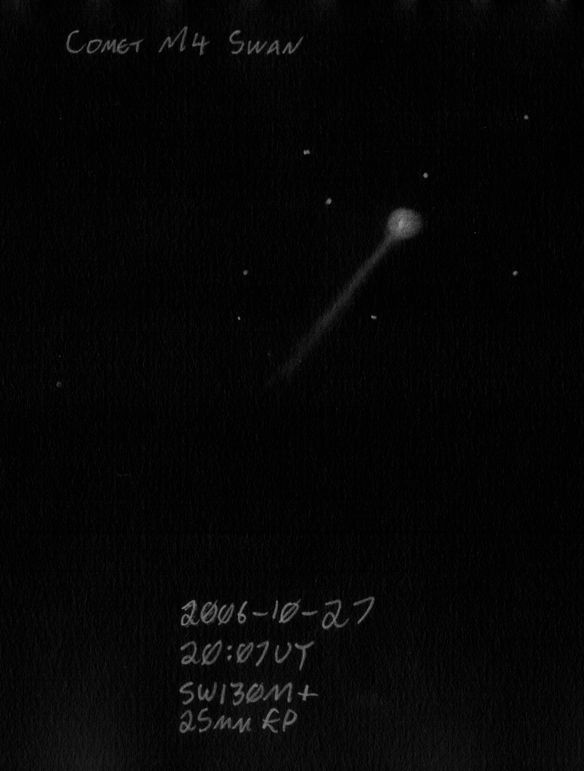
Last Friday night was another clear night so I managed to get out and view comet M4 Swan again. This time I got the 130M out to observe with and was rewarded with a pretty good view. I even had the time to attempt a little sketch too:

Just another little arbitrary milestone that's worth remembering...
File Under: Logbooks, Milestones, Amateur Astronomy.
I had another clear night last night (it's so nice to be getting out and observing at night again, especially at a reasonable hour) so I made a point of heading out to see if I could catch Comet M4 Swan. I managed to find it without any problems and had a pretty good session observing it, the full text of the log for the session is now online.
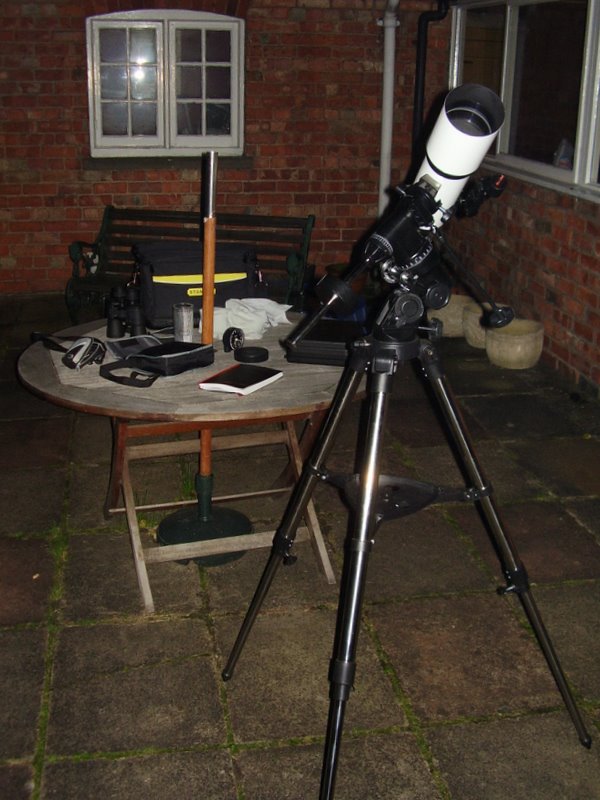

It was an interesting experience too. Unlike observing the likes of Venus, Mars, Jupiter and Saturn this required a bit of preparation and plenty of checking and double checking during the session. Also, given the nature of my equipment (I first used 10x50 binoculars and then followed up with the Antares 905), the view itself was never going to be as rewarding as most of the other planets so I found that, in this case, the real enjoyment came from finding the planet and then spending time ensuring I'd really found it.
After having found it, and after spending some time observing, I found myself thinking of a particular house in Bath, back in 1781, when William Herschel will have first realised that he'd discovered something important.
Sometimes, in this hobby, the view isn't the reward, it's the chase and the thoughts it triggers.
File Under: Uranus, William Herschel.
Via Astronomy Magazine, reporting on the earthquake in Hawaii :
The observatories atop Mauna Kea didn't escape entirely unscathed. The W. M. Keck Observatory, whose twin 10-meter telescopes are the world's largest, canceled all observing through Wednesday night. Some guiding and pointing systems were affected and must be repaired before observing resumes. Technicians reported yesterday that the primary mirrors of both Keck telescopes appear undamaged.Okay, that does it, never again will I complain about having to collimate my 'scope.
A friend has just pointed out to me that the Royal Society have opened their journal archives for free access (I'm told this will last until December).
So, anyone out there interested in a letter from someone called Mr Newton, going on about something to do with optics...
File Under: Royal Society, Isaac Newton.
I noticed something good in the forthcoming events section on the SPA home page the other day:
March 10, 2007. SPA Convention 2007, Institute of Astronomy, Cambridge. Details of the main speakers to be confirmed.Excellent! I really enjoyed the first convention in 2005 so I'm really looking forward to this!
First off, an apology. Normally I'd have placed a post such as this in my personal weblog but given the subject in question, and given how we've seen in the US that astronomy can be one of the next targets for this sort of thing, and given that one or two readers of this weblog are involved in science outreach in the UK, I thought it worth a mention — if only so I know that they're aware of this happening.
It would appear that the wedge strategy has finally found a firm foothold here in the UK. Yesterday Tim Haynes was kind enough to alert me to this article:
Creationists and anti-evolutionists in the United Kingdom have established a new website, called ‘Truth in Science’, to try to persuade school parents to lobby for their ideas within the British education system.The site in question can be found over here.
The move is the latest attempt by opponents of Darwinian theory to ‘teach the controversy’ by claiming equivalence for non-scientific theories of origins often derived from fundamentalist interpretations of Christian scripture.
[Read More]
A heads up for anyone who used to read Mark Smith's astronomy weblog:
Due to problems with Blogger (they appear to have totally lost his weblog and have not answered a single query he's sent to them) Mark's had to start again. You can find his new weblog at http://marksmith-1986.blogspot.com/.
His isn't the only astronomy weblog I've noticed go missing recently. Daily Planet seems to have gone AWOL as well.
I'm also finding that Blogger is becoming increasingly flaky (publishing seems to be a hit-and-miss affair) and I've been giving serious thought to hosting my weblogs over on the same server as my main sites. In some ways it would be a shame to have to do this, this blog is linked to from quite a few places and appears to have got a reasonable Google PageRank — I don't relish the idea of having to try and build all of that up again from scratch.
And, of course, there's all the hassle of trying to get the content over...
File Under: Blogger.
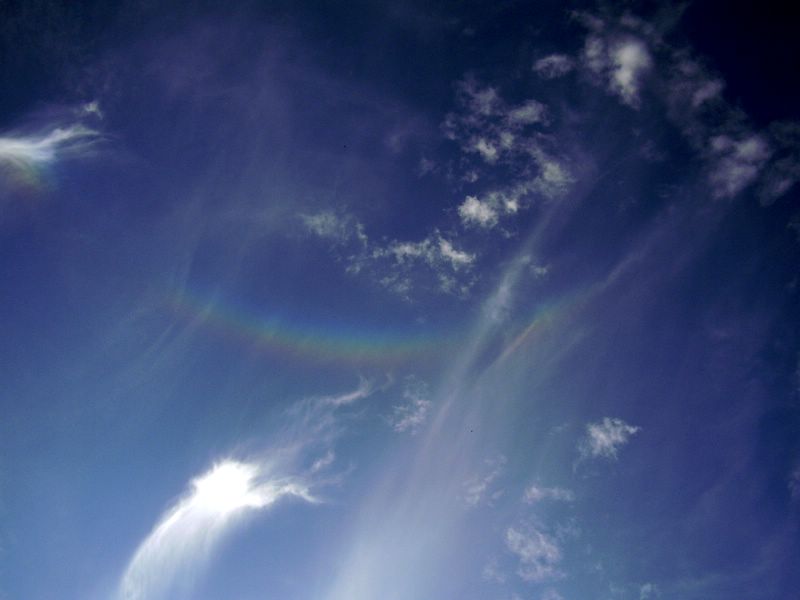
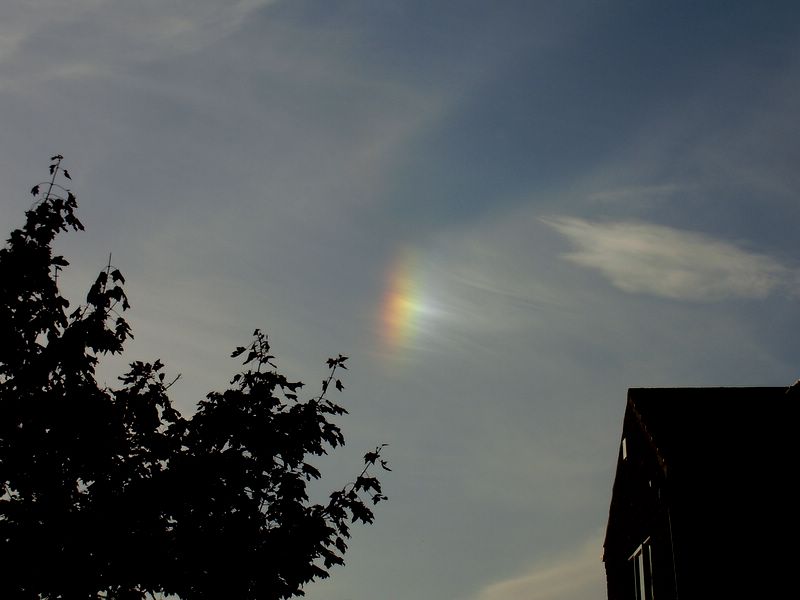
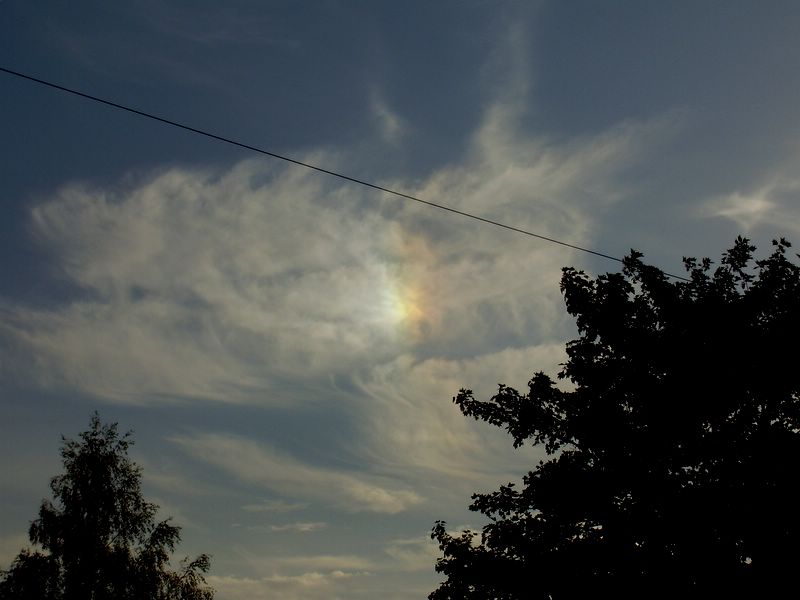
Late this afternoon I was treated to a rather nice display of a circumzenithal arc and a pair of sundogs. Using a little digital camera I tried to get a few images (the full set of images can be found over here):
Last night was a very rare event: a significant astronomical event, visible from the UK, and I wasn't clouded out.
After a very cloudy afternoon it cleared up really well in the evening so everything was on for a view of the partial lunar eclipse. Given that there was no way I'd be able to see the rising full Moon from my own garden I walked to the east side of the village to get a view out over Billingborough Fen. When I got there I had a perfect view of the eclipse around maximum phase:


On and off, this year, I've been toying with the idea of creating a "Planet" site for astronomy related blogs. As usual with this sort of "neat idea" (you know the sort of thing, you probably have a dozen a day too) I filed it away somewhere in my head, on a "I'll do that one day, no, really, I will" TODO list.
This morning, while checking the weblog stats for www.astronomer.me.uk, I noticed a new referrer in the referrer list: www.planet-astronomy.org. Looks like someone's saved me a job and have been kind enough to include this little blog in the list of feeds!
Whoever you are, if you're reading this, thanks! That's a handy resource!
File Under: Weblogs, Astronomy, Planet, Planet Astronomy.
Last week I was away for a few days holiday, first a few days staying in Whitby and then a couple of nights camping in Teesdale (staying at Highside Farm if anyone is looking for a good campsite in that part of the UK — great location and very friendly and helpful owners).
Before we set off I had a serious think about packing the Antares 905 but, given that the forecast wasn't looking too good and given that I wasn't that happy with the idea of keeping it in a hotel room for 4 nights, I decided against it. Instead I packed a tripod, L-mount and a 10x50 binocular.
The forecast turned out to be about right and during the whole week there wasn't a single reasonable clear night.
I did, however, manage to have some astronomy-related moments.
On the evening of the first full day in Whitby, at the top of the west cliff, I saw a chap putting out some signs for a star party later that evening. The society running it was the Whitby and District Astronomical Society. Even though the weather didn't look at all promising I couldn't ignore the fact that there was an AS event almost on the doorstep of my hotel. Later on in the evening I went along and had a chat with the chap running the event (sadly I forgot to take a note of his name). Normally, if the weather is good, they have a few members and many 'scopes at such an event but that evening they'd decided to keep it small.
Although I didn't get to look through anything (pretty much constant cloud) I did get to have a look at the equipment available and had a good chat about the problems and rewards of running an astronomical society.


Having been rather busy with other things I've not had the chance to write about the news regarding the IAU's vote about the definition of a planet. There's little point in doing so now given that pretty much everyone else has written about it.
But I did realise one small side-effect: with only eight planets in the solar system they should all now be in easy reach of my equipment. ;)
File Under: IAU, Definition of a Planet, Pluto.
Stuart, over at Astronomy Blog, seems to have set himself up as a spymaster.
Well worth a read if you're interested in that uninteresting subject.
Of course, like Stuart, I will point out that there are plenty of interesting astronomical issues being discussed during the week other than this.
File Under: IAU.
Not long after the proposed definition of a planet was published I saw a couple of reports that mentioned that pluton (the term the IAU have proposed to describe "Pluto like" objects) is a term used by geologists to describe a type of rock.
I admit that I wasn't aware of this until I read it, but after reading it I did think it a little odd that they'd try and overload the word in this way — it's not like geology and planetary science are fields that don't overlap.
Reading an article in Nature this morning it seems the committee were aware of the term but took a very curious route to deciding if they should overload it or not:
Owen Gingerich, an astronomer at Harvard University in Cambridge, Massachusetts, and chair of the IAU committee that created the definition, says that they were aware of its usage amongst geologists, but unaware of its importance to the field. "Since the term is not in the MS Word or the WordPerfect spell checkers, we thought it was not that common," Gingerich wrote in an e-mail to news@nature.com. The geologic definition of the word does appear in common dictionaries, including the Oxford English.What a really strange approach to things! I'm loath to take a quote in isolation but the above really does seem to suggest that they used common spell checking software, rather than a dictionary, to decide if they should use the word or not.
Today has generally been cloudy but I've just had a brief clear spell so I took the Solarscope out to do a quick sunspot count.
I could only see a single, large spot in AA904 (which was now very close to the limb of the Sun).
I had quite a surprise when I noticed, right on the opposite limb of the Sun (to the point that it seemed to be right on the limb), a spot that appeared about as big as the one in AA904. I've checked on Spaceweather and with Solar Weather Browser but I've yet to find an ID for the area.
I think this is the first time I've caught a sunspot before an ID has been published on the popular solar weather sites.
File Under: Sun, Solar Observing, Sunspots, Active Area 904.
This afternoon I had another chance to observe active area 904. While I still had to do battle with cloud I did have the time to take a naked-eye look (via eclipse shades — yes, I could see the main spot) and I also had the chance to do a couple of rough sketches (an attempt at a general view of the Sun and also an attempt at some detail of 904).
File Under: Sun, Solar Observing, Sunspots, Active Area 904.
We're not that far into the first day of the general availability of the IAU's draft resolution for the definition of a planet and, already, there seems to be signs of confusion.
Alok Jha, writing for The Guardian, says:
If the ideas are approved at the general meeting of the IAU in Prague next week, schoolchildren will, in future, have to learn that the solar system has 12 planets: eight classical ones that dominate the system - Mercury, Venus, Earth, Mars, Jupiter, Saturn, Neptune and Uranus - and four in a new category called plutons.That's not quite right, Ceres won't be a "pluton", the idea is that it will be known as a "dwarf planet". As well as the draft resolution saying this:
These are Pluto, its moon Charon, a spherical asteroid that sits between Mars and Jupiter called Ceres, and an object called 2003 UB313 but nicknamed Xena by American astronomers who found it.
We recognize that Ceres is a planet by the above scientific definition. For historical reasons, one may choose to distinguish Ceres from the classical planets by referring to it as a "dwarf planet."the question and answer sheet that goes with it is also quite explicit about it:
Q: Is Ceres a "pluton"?If a science correspondent is getting this wrong you've got to wonder how the public at large will comprehend it.
A: No.


