2007-04-30

AA 10953 on 2007-04-28

I managed to observe the Sun both days of this last weekend. The spot in active area 10953 continues to look pretty impressive (well, impressive by "we've not had much to look at for a while" standards). I didn't take a photograph on Sunday because conditions were far from ideal but I managed to get this shot on Saturday:

2007-04-27

Randomness

I just had a rather silly idea, and it took no time to implement.

I was thinking that I've got a lot of observing logs now and, to a large degree, I can generally find the one I want (often via the log index). But it might also be fun to have a facility that selects a random logs.

So that's what I did: view a random observing log.

Finally!

During the past couple of months I've had a pretty good run of clear days that have permitted lots of sunspot counts. However, the last time I actually saw a sunspot was 2007-03-03.

That finally changed today:

2007-04-23

Astroblast 2007 - Photographs

I made it to Astroblast and had a really good day out. I don't really have time to write about it at the moment (although I do hope to some time soon) but, meanwhile, here's a gallery of photographs I took while there.

You wouldn't believe the trouble I had to go to to smuggle them out of the event.

2007-04-20

Astroblast 2007

Tomorrow is Astroblast 2007. All being well I'll be going along again.

Looking at the website it appears that it'll be pretty much the same sort of thing as last year which, from my point of view (father with small child), isn't necessarily a bad thing.

Personally I found last year's effort to be quite enjoyable. I read a few negative reviews and most of the complaints seemed to revolve around the issue of it being "a bit lightweight" or "too aimed at children" — which I thought was kind of odd given that it seemed pretty obvious from the website that it was very much aimed at being a family day out with a particular emphasis on children. As someone interested in astronomy, who has a child and a wife who isn't that interested, it's nice to be able to go along to something relating to astronomy with my family and without them being bored stupid (let's be honest, the "hardcore" events have nothing of interest if you're not deeply interested in the subject).

The only complaint that made real sense was about the lack of catering facilities. As I understand it, this year, this won't be a problem (or so I was told by someone on the Greenwitch stand at this year's SPA convention). It's odd, though, that they don't seem to mention this on the Astroblast website.

2007-04-18

The ISS, Leo and Saturn

Tonight I had my first go at photographing the International Space Station.

Earlier in the day I saw on Heavens Above that there would be a good pass this evening so I decided to have a go at photographing it. I went out with about 15 minutes to spare and set the Canon EOS 400D up on the tripod and did a few test shots. I had a hell of a time trying to get it focused well but managed to get close to something useful before it was time.

Just as the ISS approached I realised that I had the shutter speed set to 30 seconds rather than bulb and that I'd not yet used the remote in bulb mode and wasn't exactly sure how it worked so, rather than miss the pass, I just went for the 30 second exposure. This is the result:

International Space Station
Click on the picture for a bigger version

That's the jpeg straight off the camera, just with a slight crop, a tweak of the levels and a resize before uploading to my Flickr account.

It's not perfect, but as a first attempt I'm pretty pleased.

Growing up in the Universe

Not exactly astronomy, I know, but I'd imagine that most people reading this will be interested in the following, for more than one reason.

Richard Dawkins' 1991 Royal Institution Christmas Lecture will soon be available to buy on DVD. Earlier on this month a short advert was made available.

Now there's a short excerpt available, and (for me anyway) it's made all the more special because of who appears in it.


I am so going to be buying a copy!

2007-04-04

Saturn and a mobile phone

Sorry about this, but this is yet another one of those "look what I imaged with my mobile phone" posts. I know it's not big, I know it's not clever, but, but, because I can....

This evening I was out observing Venus for a while and then, when Venus got low, I turned to Saturn. What a view! One of the best I've ever had. And, as I have a horrible habit of doing, in a moment of madness I decided to see what I could capture with the mobile phone. This is what I got:


Okay, Damian Peach it isn't, but you can at least tell which planet it is.

2007-04-03

Accidental stereogram

Not exactly astronomy, but it does relate to one of my telescopes...

Over the weekend I was taking some new photographs of my two 'scopes to replace those on the tools page of my site (the ones that had been there had been taken with mobile phones and were of terrible quality). While reviewing the shots yesterday I noticed that two of them appeared to be taken from almost exactly the same spot and at exactly the same height.

In other words, I appeared to have accidentally created a stereogram. I then placed them side by side in one image and got this result:

Sky-Watcher Explorer 130M Stereogram

If you're the sort of person who can go cross-eyed without any trouble you should be able to see the 3D effect. Click on the image for a bigger version.

Newton from space

The most recent Google Maps update has seen the addition of lots of new high resolution images for Lincolnshire. Not only have the areas that already had hi-res images been updated, lots of new areas have been added.

So, I was having a look around and seeing what I could see and I noticed that, finally, Woolsthorpe-by-Colsterworth was covered. Because of this it's now finally possible to get a good view of Woolsthorpe Manor. The manor itself is the building in the top left corner of the cluster. If you look carefully in the small field to the left of the cluster of buildings you'll see some of the (in)famous apple trees.

Newton himself is also now visible thanks to this new update. Well, okay, not Newton himself, but if you look carefully you can see the shadow of his statue in Grantham.

Venus

As I noted a few days back, I've finally been observing Venus via a telescope (to the best of my knowledge this year is the first time I've ever done that). The log from the first session can be found here, the second session was a couple of days later.

Two things stand out so far. The first is that these sessions are probably the first time I've noticed filtering making a big difference to a visual image. I've found that, on the 905, a combination of the contrast booster and a 80A medium blue work really well.

The second thing I've noticed is just how tricky a target Venus is. While it's obvious that I've been observing something that has a gibbous phase I've been struck by how indistinct the view is. Of course, this won't be helped by the fact that I'm observing Venus when it's quite low to the horizon – lower than I'd generally observe other planets. It's probably also not helped by the fact that I'm not really using the best 'scope for the job.

But! Will Gater comes to the rescue. His great picture of Venus reminds me an awful lot of the view I've been having of Venus (albeit my view is obviously somewhat smaller than that). It's always nice to have something to compare to and that image really helps.

2007-04-02

A quiet month on the Sun

Going on my records, and keeping in mind the limitations of my equipment, March was a very quiet month for visible solar activity. I managed 20 sunspot counts last month and only saw a sunspot for the first two days of the count. From what I can tell that's the least active month I've observed since I decided to do regular counts starting March last year.

2007-03-29

Close approach of asteroid

Seen over on the BBA website:

Asteroid 2006 VV2 passes close to the Earth at the end of March and the early part of April. At its closest, on March 31, it will be 0.0226 AU away (8.8 lunar distances). This will be the closest known approach by an object this intrinsically bright until May 2036, when binary asteroid (66391) 1999 KW4 (H=16.4) approaches within 6 lunar distances. Observers should be able to see it through modest telescopes as it reaches 10th magnitude on March 31st and April 1st.
That sounds worth keeping in mind and having a hunt for if I'm out and observing at the right sort of time.

Fun Flickr Sunsets

I recently started having a play around with Flickr (and I'm mostly impressed by it; it is a little easier than maintaining my own photo gallery) so when I saw this story on Astronomy Blog this morning it really caught my attention.

How cool is that?

I just love it when the "obvious" is found in "not so obvious" places.

2007-03-26

Venus at Sunset

There was a really nice looking sunset yesterday evening, just a touch of mist, really nice subtle colours in the sky. I just had to grab the camera and head out to the edge of the village and run off a few pictures.

While they don't quite qualify as astrophotography I did make a point of including Venus in some of the shots.

Even better, when I got back home, I noticed that Venus was still visible from my back garden. I immediately got the Antares 905 out and had a session observing the planet. I think this is the first time I've ever observed Venus through a telescope. It's definitely the first time I've observed it via a 'scope since I got back into observing.

2007-03-22

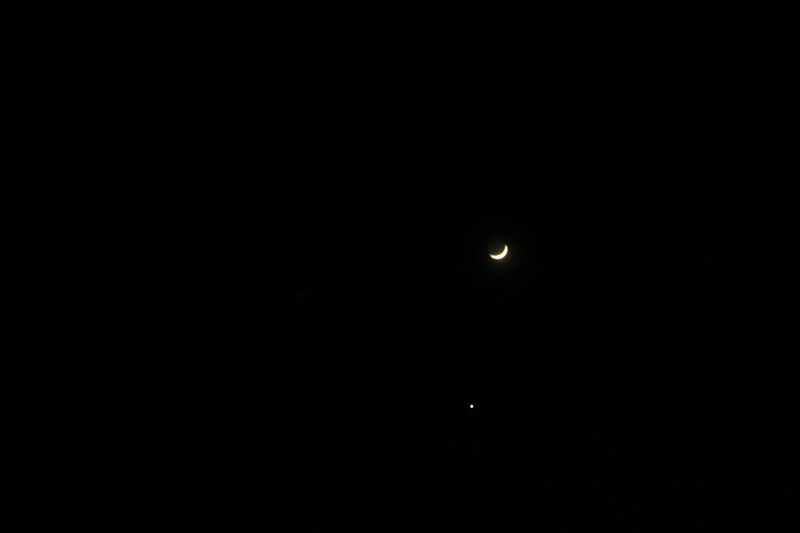
Moon and Venus

I was lucky enough to have some clear skies last night so I went out with the EOS 400D and a tripod and took some photographs of the Moon and Venus together.

As it was they didn't turn out that well, I really need to work on getting the focus right.

I notice that Ian also took some images and also did an animation too. Although, as always, he seems to have managed to photograph everything upside down. ;)

2007-03-20

Star Cards

Last Saturday I was up in York, visiting family. While up there we took a trip to the Castle Museum. There wasn't an awful lot there related to astronomy (there was a display case full of instruments made by T. Cooke & Sons — which included a really nice brass achromatic telescope) but, in the display of children's toys, I did find these rather nice "Star Cards":


Sadly I couldn't see any information about them. I'd love to know who made them and what the story was (and how many there were in a set).

They reminded me of the time when, as a child, I made my own set of constellation cards.

2007-03-15

BAA/CfDS/CPRE star count results

The BAA website now has the results of the December and January star count.

Nearly 2,000 people took part in the star count. Only 2% of people who responded to our online survey said they could see more than 30 stars, compared to 54% who saw fewer than 10 stars in Orion – a level which indicates severe light pollution.
Have a look at the article for a full breakdown of the results (there's also a map of the results too).

Also, don't forget the GLOBE count. I've not had the chance to have a go yet, but time and weather permitting I'm planning on it.

2007-03-12

SPA Convention 2007 - A Short Report

It's been almost a year and a half of waiting but, finally, last Saturday arrived and it was time for the second Society for Popular Astronomy convention.

The day was laid out similar to that of the first convention with various talks during the day, the main talk being The Planet Venus and the Venus Express Mission by Professor Fred Taylor. Alongside all the talks were various stands by the sections of the SPA and also various stalls hosted by a number of vendors of items relating to astronomy.

The doors opened around 09:30 and the main reception area seemed to fill up very quickly – for a short while there was even a queue to get in. Around 10:00, after people had had a chance to get in, get a drink (drink and food was available for sale all day) and have a look around some of the displays and stalls, the bell was rung and people filed into the lecture theatre to hear Dr Ian Crawford deliver the welcome and then hand over to Nik Szymanek for the first talk of the day.

The talk was mostly for beginners and provided plenty of information on how to get started photographing the night sky. Nik also went on to relate some of his experiences photographing from the top of La Palma while showing us some of the results acquired during such trips (including some excellent images of daytime atmospheric phenomena).

A tea break followed and I joined a guided tour of the Thorrowgood and Northumberland telescopes. The Thorrowgood telescope had been set up to track and project the Sun (and, as you'd expect, this happened to be a day with no sunspots visible) while the Northumberland had been set up to track Venus. Sadly, during the tour I was on (there were many such tours available during the day), there was just enough cloud cover to make such an observation impossible.

When I got back from the tour it was time for Nik's second talk of the day, this time an interactive question and answer session dealing with all aspects of astronomical imaging. Given that I'm not that interested in imaging at the moment I decided to skip this and, instead, have a wander around the stalls. I had a chat with Greenwitch — mostly about last year's and this year's Astroblast (the good news is that this time round there will be catering!) – and I also had a good look around the stall run by Astronomica (while there I picked up an affordable 2x barlow to replace the rather terrible one that came with my Explorer 130M – I'm hoping it should do a better job and I'll report on that when I get the chance to try it out).

The next talk was in two parts, the first was about the Terran Planets and was delivered by Michael Hezzlewood; the second part was about observing Saturn and was delivered by Ian Phelps. The talks were slightly delayed due to problems with the projection system and part of the talk was slightly marred by the lack of a microphone (leading to the occasional shout of "speak up!" from the back of the room). Despite the technical problems both parts of the talk turned out to be interesting and informative.

After that talk I spent some time wandering around some more before having lunch. Around this time it was pointed out to me that Martin Rees was wandering around (given that we'd taken over his place of work for the day I guess it was no surprise) and he was kind enough to pose for some photographs.

Finally it was time for the main event: Professor Fred Taylor's talk about Venus and the Venus Express mission. It was great to see that the talk itself had been over-subscribed and that the lecture hall was packed out (despite having a ticket I ended up sitting on the floor at the front, although that was because I'd been helping out checking tickets on the door).

Professor Taylor started out with a background of Venus, paying particular attention to those questions that Venus Express was designed to answer. I found this pretty fascinating given that I thought I knew pretty much everything there was to know about Venus (at least, things that would be interesting to and understandable by an amateur with a layman's interest). I was particularly fascinated to learn about the Venus Polar dipole.

Professor Taylor then went on to explain some of the background and design of Venus Express, following up with an explanation of what it would be doing for the duration of the mission and also telling us about some of the results that have been acquired so far. He then finished off with a really fascinating sequence of slides that illustrated a visual connection he'd made between the latest images of the polar dipole and the Lorenz attractor.

Another tea break followed and after that was a quick talk about Comet McNaught followed by a talk entitled Instruments for Planetary Observing. I skipped these while I took the opportunity to have another look around the various stands (and to also start helping with a bit of tidying up). The day then finished off with the raffle (I didn't win anything, Paul Sutherland, on the other hand, managed to win twice – grrrrr!).

In conclusion, from my point of view, the day was an incredible success. I spoke to many people during the day and every one of them said they they were really enjoying themselves – this included people who weren't members of the SPA (but, fingers crossed, will be some time soon). I really enjoyed it. The talks were interesting, entertaining and informative. The atmosphere of the whole day was friendly and welcoming. It was great to meet up with various names from the SPA again. It also felt like it was all over far too quickly.

It now looks like the convention will be held every other year and the next one, in 2009, promises to be extra special.

I can't wait.

SPA Convention Photographs

I've not had the chance to write up a report of the SPA convention just yet. I have, however, uploaded my photographs of the day.