2007-03-07

World-Wide Star Hunt

Back in December last year I reported on the BAA/CfDS/CPRE star count. Stuart picked up on this and, in the comments on Stuart's blog, Ian sort of got to thinking about an international effort to do something similar.

This morning I had an email from Robin Scagell, alerting me to Globe at Night. Here's an excerpt from the press release:

The international star-counting activity known as GLOBE at Night returns from March 8-21 in two flavors: the "classic" GLOBE at Night exercise that anyone can have fun doing with their unaided eyes, and a new effort to obtain precise measurements of urban dark skies using digital sky-brightness meters.

The GLOBE at Night 2007 program is intended to build upon the worldwide participation sparked by the first GLOBE at Night campaign in March 2006. This inaugural effort drew more than 18,000 citizen-scientist participants in all 50 U.S. states and 96 countries worldwide, who submitted nearly 4,600 observations of the darkness of their local night skies during the 10-day event. The program is designed to aid teaching about the impact of artificial lighting on local environments, and the ongoing loss of a dark night sky as a natural resource for much of the world's population.
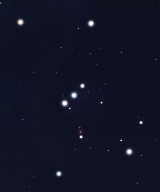
It seems they're also using Orion as the patch of sky for doing comparisons and, helpfully, they have a set of magnitude charts to help in estimations (and don't you just love the fact that they've produced just such a chart from a cloudy night).

There's even a nifty little tool for testing your estimation ability.

This all sounds like just the sort of thing that Ian will like.

Lunar Eclipse Movie

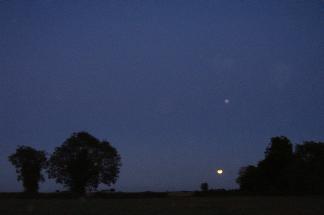
Tim Haynes (friend and BOFH for the machine I host my websites on) was also out on Saturday night, observing and photographing the total lunar eclipse.

Not only did he take a whole load of images of the event, he also produced a pretty neat video of it too:


It's a shame that the Moon has got squashed in the YouTube version (the original looks better) but, that aside, I think it's a pretty neat record of the event.

2007-03-06

What the hell is happening?

After reading this entry on Rich Daley's blog I was reminded of something I was thinking about on Saturday night.

What do people who have no knowledge or interest in astronomy make of something like a total lunar eclipse? Here in the UK you'd be hard pushed to find someone who didn't know that a total solar eclipse was coming, it's such a rare occurrence that it would be reported everywhere for days prior to the event (as it was in 1999). Most partial solar eclipses won't be noticed, most people who haven't been told about it won't know it's happening.

Partial lunar eclipses probably aren't noticed either, I'm guessing that most people, even if they noticed that part of the Moon was missing, would assume it's just one of the Moon's phases (it's not uncommon for people to think that the Earth's shadow is responsible for the Moon's phases).

But a total lunar eclipse seems a little different to me. It's one of those events that can be reported in such a way that people don't know it's happening (personally I only ever saw mention of Saturday's eclipse, in passing, during weather reports on the BBC news) while, at the same time, is very obvious to the naked eye – if you were out and about on Saturday night you'd be hard pushed not to notice that the Moon was full but wasn't bright and was a very strange colour.

I wonder what Rich's bouncer was really thinking. I wonder what ideas had gone through his mind. I wonder what possible reasons he'd entertained. I wonder how many other people were in the same position last Saturday, faced with something out of the ordinary, something impossible to ignore, something needing an explanation. I wonder what hypotheses they entertained.

2007-03-05

Lunar Eclipse 2007-03-03 - Log now up

I've now uploaded my observing log of the total lunar eclipse.

Lunar Eclipse 2007-03-03

As I'd hoped a couple of days earlier the weather played ball and last Saturday night was nice and clear.

So I got to observe the whole of the total lunar eclipse. For some detail of my observing session have a look at the short report I wrote on the SPA BB this morning – I'll be adding my full observing log later on today.

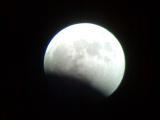
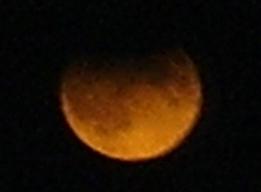
I didn't bother to attempt any photography (other than a few afocal shots with my mobile phone, through the Antares 905 – a small example can be seen above), I just wanted to observe and enjoy the whole event (and it's not like it wasn't going to get photographed by anyone else <g>).

I thought totality was reasonably dark, personally I'd rate it as L2 on the Danjon Scale.

Just one downside to the whole event: I managed to stand on my glasses and scratch them so badly that they're not really useful any more. Thanks to that I think this has been my most expensive observing session yet. It was also kind of annoying to find myself observing a great naked-eye event and find that the only bit of optical equipment I had with me that wasn't working was.... my eyes.

There was a nice little bonus to the whole evening though. After we'd packed up (after last umbral contact), and because there was so much dew on the grass, I stood with my back to the full Moon and noticed a nice, if faint, example of Heiligenschein.

2007-03-01

Welcome to March

So, it's March again. March is sort of important to me in astronomy for a few reasons:

All being well March should be good this year too. First up, weather permitting, is Saturday's lunar eclipse. The current forecast from the Met Office is for clear skies on Saturday night.

Secondly, a week on Saturday, it's the 2nd SPA convention. I'm really looking forward to that. The first one in October 2005 was very enjoyable so I'm expecting this to be a good day out too.

So far it's been a terrible start to the year, other than a couple of brief views of comet McNaught, and a brief session observing the Moon and Saturn, I've hardly been out so far this year. I'm hoping that the next two or three months offer up some good nights before the long days of summer take over.

2007-02-22

Collapse of Rover hits UK astronomy?

According to this story on the BBC website:

UK science has become an unexpected victim of the Rover collapse as funds used to soften the impact of the failure were clawed back from research.

The Department for Trade and Industry said it faced financial pressures that required it to re-balance its spending.

Ongoing costs related to the loss of the Rover car company and the rescue package put together for British Energy were cited as causes for the shortfall.

It means £68m given to the UK Research Councils by the DTI will be taken back.
Towards the end of the article there's a list of various research councils and the impact it will have, one of them is:
Particle Physics and Astronomy Research Council £3.1m
That can't be good, can it?

Next week's lunar eclipse

Like Will, I'm already thinking about observing next week's lunar eclipse.

All being well, weather permitting (sadly the 6 to 15 day forecast from the Met Office doesn't give much of a clue about what to expect), I'm hoping to join a fellow observer a Woodland Waters (somewhere we've used once so far and were very happy with). The horizon there is pretty good and should give an unobstructed view of the whole event.

Even though I now own a dSLR it's unlikely that I'll be taking any photographs of the event due to the fact that I don't have the kinds of equipment that make it worth it, although I might try something — during the last lunar eclipse the fact that I only had a compact digital camera didn't stop me from trying to make some sort of photographic record.

Visually I'll probably be using a 10x50 binocular and the Antares 905. Pretty much all of my observing will be visual and, of course, I'll be keeping a written record of the event.

Fingers crossed that the weather plays ball again...

2007-02-21

Sir Patrick's Day?

While it's nowhere near as odd as some e-peitions, this one caught my eye for the obvious astronomy connection:

We the undersigned petition the Prime Minister to Mark the 4th of March as a National Holiday in honour of Sir Patrick Moore's Birthday.

Sir Patrick Moore's extensive contribution to the rich scientific heritage of this nation should be rightfully recognised. We believe a National Holiday on the date of his birth: March 4th, would prove an apt and just cause for celebration and merriment as well as providing much appreciation of the scientific world.
Not that I'll be adding my name (mostly because we don't need any more public holidays in the UK, but also because I can think of better people to honour if such a thing were ever to be done).

2007-02-20

The UK's own space program

Last Sunday evening I was treated to one of the best TV moments ever: Top Gear (I really don't care for cars much, but Top Gear isn't really about cars anyway) kicking off the UK's very own space program (yes, yes, I know, we used to have one):


For anyone who doesn't know what that actually is, it's a Reliant Robin.

That alone was worth the cost of this year's licence fee.

Dobsonian vs Equatorial

Via this post on the SPA BB:


Hmm, okay...

2007-02-16

No more Night Sky

Stuart is reporting that Night Sky magazine will be no more. That's a real shame.

I first noticed the magazine, here in the UK, back in early 2005 and I've been buying it ever since. While it is more of a "beginners" magazine and I probably don't really count as a "beginner", I always found it to be an enjoyable read.

I hate Pete Lawrence

Well, okay, I don't really hate Pete Lawrence, but just when you think he can't get any more talented, or lucky, he goes and does something like this.

That's just showing off!

2007-02-15

Astronomy Now, and some other bits

I had a parcel turn up today. In it was a copy of the March edition of Astronomy Now and a copy of the Astronomy Now 2007 Yearbook.

I hadn't ordered them.

This was AN's way of saying thanks for me letting them use a version of this post in an article of reports about Comet McNaught.

The free copy of the magazine was expected, but the free copy of the yearbook wasn't. I thought that was rather nice of them.


I've not done much in the way of observing in the past few weeks. I've not even managed much solar observing thanks to the weather. We did have a clear spell last night and I did wander out to have a look at the skies with a view to getting the EOS 400D out and possibly doing a little more constellation photography but cloud rolled in while I was assessing the sky.

Which sort of fits in nicely with the current news about Mira. It would be neat to get some shots off of that area of sky, then take some more later on down the line and compare the images.

2007-02-05

A little bit of astrophotography

On Saturday evening I finally caved in and, while I had a space moment, I decided to give my Canon EOS 400D a quick go under the stars.

Conditions weren't ideal, mist was starting to form, but I dragged the tripod and camera out anyway. I played around with different exposure settings and generally got to know some of the features of the camera that I might want to use if/when I do some astrophotography (I'm more interested in using the camera for "straight" photography than I am astrophotography — I think I'm still more into observing than I am photographing).

Probably the best of the bunch was this one of Orion. It's trailed a little (no surprise) and I think the focus is a little off too, but M42 is clearly visible and, I think, I even managed to catch a faint meteor (look in the top half of Orion's "body").

2007-02-01

Sundogs and Circumzenithal Arc

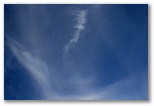
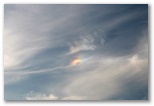
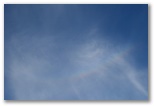
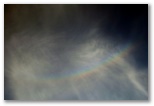
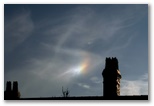
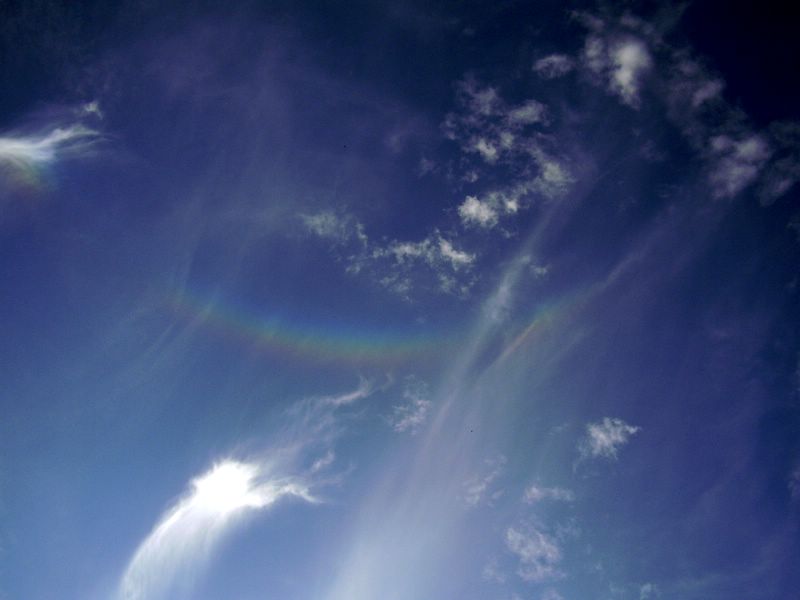
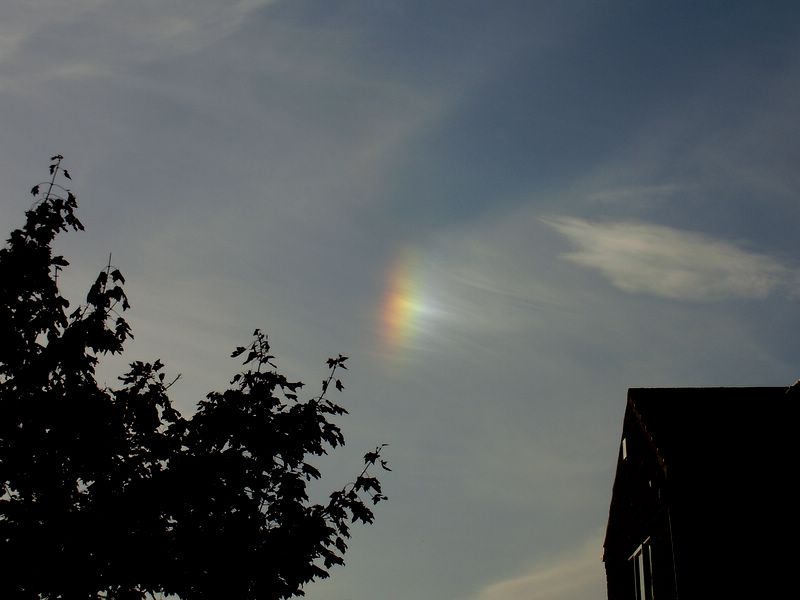
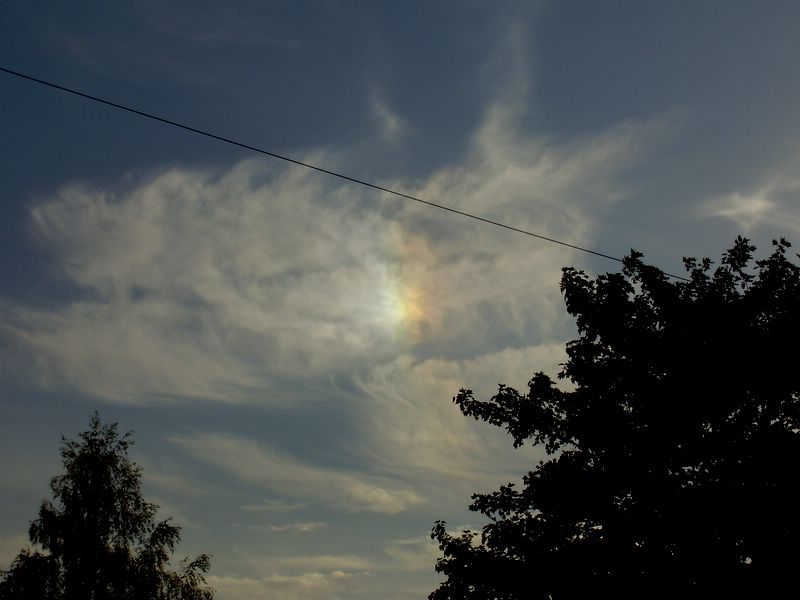
This afternoon I was lucky enough to catch a display of a pair of sundogs and a circumzenithal arc. The arc was rather faint, nowhere near as good as the last display I saw. Despite this I grabbed my camera and tried to record what I saw.


2007-01-24

Logs by comet

Now that I've observed a handful of comets I've got around to adding another way of getting at my logs: by comet.

There aren't that many there at the moment. Let's hope this situation improves this year.

Another light pollution petition

There is another light pollution petition on the UK PM's e-petitions website. Unlike the last one, this one is more concerned with all forms of outdoor lighting:

We the undersigned petition the Prime Minister to ensure that all exterior lights are shaded to direct their light downwards, so as to prevent light pollution obscuring the beauty of the night sky.

For those who live in our towns and cities, the night sky is filled with a dull orange glow punctuated only by the dim glimmer of an occasional bright star or planet. Fitting well designed shades on all exterior lights would stop light leaking wastfully upwards, restoring the glorious beauty of a star strewn sky overhead. Bring back the milky way!
Shame about some of the problems with the text of the petition, but it's got to be worth a signature if you're in the UK.

2007-01-17

The Star of the East

What is it with artists and light pollution?

According to this article in Louth Today Mablethorpe is to acquire an installation that is based around a "star". To make things more annoying "an electric light at the top of the Star will light up and change colour – creating a lighthouse effect". Around this are a series of lines in the ground, each one of them is supposed to represent "an important date in Mablethorpe's history", one of which is "the little known Mablethorpe meteor of 1898 which exploded in the sky over the resort".

So, let me get this right: they want to commemorate an event in astronomy by... creating light pollution? How very clever.

According to Michael Trainor, the "Manchester based artist" who designed it, "Mablethorpe is the only town in the UK to have its own star". I bloody hope so!

2007-01-13

Google Earth/Maps European Light Pollution Overlay

This seems to be turning into an evening of links via the SPA BB — sorry about that.

Via this post on the SPA BB: a European light pollution overlay for Google Earth and Google Maps.

Night Earth

Take Google Maps. Take NASA's image of Earth's city lights. Lay the latter over the former, mix, and you get Night Earth.

Very cool.

Yet another interesting little nugget found on the SPA BB.

The British Astrological Association

It must be a week for this sort of thing. Not only do we have one UK paper running an article about how comet McNaught will affect your love life, I now see from an article on the SPA BB that a report in The Telegraph about the BAA/CfDS/CPRE star count talks about the British Astrological Association.

Is it really too much to ask of the popular press that they treat the subject anything close to correctly?

No, that's okay, I know the answer to that question.

2007-01-12

Comet of Destiny

From earlier:

Also, talking of Paul Sutherland, I guess I should mention my tabloid shame. ;-)
Just to be clear, I can't stand The Sun, it's an awful newspaper, truly awful — it feels wrong to even call it a newspaper, but...

Paul's a fellow admin on the SPA BB, when he asked if he could borrow some bits that I'd written about the comet for an article he was working on I was more than happy to oblige (even knowing where it might end up). Anything that gets a story about astronomy out, if it's done well, is worth supporting. I knew where the story might end up but, ahh, what the hell...

So, okay, the story as it ended up in the paper (and, yes, it is in the actual paper too, my mother will be so proud) is very short on detail, but at least it doesn't make stupid claims and doesn't misrepresent anything. It might just have got a few people to poke their heads outside during the evening and try and take a look. Unlike this pile of total nonsense in The Daily Mail.

I could rant on about that all afternoon, but I'll save myself the trouble and point to the Bad Astronomer's page dealing with astrology instead. Yes, I know, no regular reader will need to be told any of this, we all know that astrology is wrong, but you never know who might end up here via a search.

In comparison to that pile of total nonsense a story about a pub toilet seems very sensible.

Comet 2006 P1 McNaught Pt II

After a day of lots of cloud and near-damaging winds things cleared up a little into the evening so I took another stroll to the edge of the village to see if I could get another view of the comet.

Conditions weren't ideal, it was rather murky and there was a fair bit of cloud on the western horizon. Unlike the previous evening I didn't manage to catch a glimpse of the comet on the walk down, I only managed to see it once I got to the chosen observing location.

This time it took a few moments to find it, it was nowhere near as obvious as the day before. In a way it was kind of disappointing, but that's only because I'd been so spoilt by the previous view.

Over on the SPA BB Robin Scagell has posted a rather nice image from last night. Paul Sutherland has also posted an image that seems to give a good impression of how it looked to me last night (not as obvious as the previous night).

Also, talking of Paul Sutherland, I guess I should mention my tabloid shame. ;-)

2007-01-10

Comet 2006 P1 McNaught

I've just got back into the office after having a wander out to the western edge of our village, hoping to catch a glimpse of comet 2006 P1 McNaught.

While having dinner I'd mentioned that I was going to go for a walk and have a look and my son asked to come along too. Given that he's not quite 5 and given that I'd be using a binocular my wife decided to come along too — the best place to observe is next to a reasonably busy road (especially busy around 17:00 or so due to people heading home from work) and that wouldn't be a good mix.

I'd told them both that I didn't quite know what to expect. From what I'd read so far I was expecting a small fuzzy comet, probably visible to the naked eye with some effort, but probably requiring that I find it in the 10x50s first. We got coats and hats and stuff on and started walking down the road. About ½ way to the edge of the village I saw something out of the corner of my eye, through some trees. I looked, did a double take, and then a triple take, and then almost said the sort of phrase a father shouldn't say in front of his child.

It was a comet! Not a little fuzzy thing, not the sort of thing I've struggled to find in binocular and telescope over the last year or so, this was a proper naked eye comet. Bright head, easy to see tail, skirting the horizon in a really nice looking sunset.

I was shocked and amazed. As was my wife and son. To be honest, it's hard to say who was most excited, although I think my son wins ("I've seen my first comet! I've seen my first comet!").

I won't bother even trying to relate any technical details, I wasn't really paying attention to it in that way. About all I managed was a quick estimate of the length of the tail (about 2 widths of my thumb, held at arms length) and that was about it. The best I could really manage was to just stand there, awestruck, repeating things like "oh wow", "that's huge!", "look at it! just look at it!" and other pointless variations on that theme.

Within around 10 minutes the head had set behind some trees and I watched the tail slowly set for a couple of minutes more.

I'm still really excited, I'm still feeling kind of shocked and moved by it. I'm still feeling very inadequate when it comes to trying to relate what I saw and how it felt to see it.

Don't you just love it when the Universe surprises you like that?

Update: BAA/CfDS/CPRE Star Count

The BAA are reporting that 72 observations of Orion were received in response to the Christmas star count. That might seem rather low but it's not surprising given how awful the weather was for many people during the allotted time (I was pretty much under a constant blanket of fog so never got to do a count).

Thankfully there's going to be a second attempt:

There is another chance as the survey will re-run over the next new Moon period, from Jan 14 - Jan 21, between 9.00-11.00 pm which is just right for catching Orion 'high in the sky.'

Ignoring the Sun

Ever since I wrote about the UK floodlighting petition back in November I've been keeping an eye on the e-petitions site (its RSS feed makes this nice and easy). Some petitions are obvious, some are amusing, some are kooky and some are just outright strange.

I saw one this morning that probably falls under amusing, or perhaps just misinformed:

Why bother changing the clocks? Greenwich Mean Time is valid all year round. Midday indicates that the sun is highest in the sky; changing to BST over the summer suggests that we should ignore what the sun does when we plan our lives.
Nice enough idea I guess but there's a problem with the reasoning. There's a reason why Greenwich Mean Time is called Greenwich Mean Time — I'll borrow a paragraph from Wikipedia to explain why:
Noon Greenwich Mean Time is not necessarily the moment when the Sun crosses the Greenwich meridian (and reaches its highest point in the sky in Greenwich) because of Earth's uneven speed in its elliptic orbit and its axial tilt. This event may be up to 16 minutes away from noon GMT (this discrepancy is known as the equation of time). The fictitious mean sun is the annual average of this nonuniform motion of the true Sun, necessitating the inclusion of mean in Greenwich Mean Time.
In other words, even when we're working with GMT, we're still "ignoring what the Sun does" (well, not really, but I'm trying to use the line of thought of the author of the petition).

And now for the gratuitous use of the word analemma, which gives me the perfect excuse to link to Anthony Ayiomamitis' amazing images.

2007-01-09

Fireworks

Fireworks probably aren't an astronomer's best friend (ask any UK astronomer who wants to observe on the night of the 5th/6th November) so they might not seem like an appropriate subject for an astronomy weblog. But...

A little earlier I was having a look at the latest challenge results on DPChallenge.com and noticed this image in 3rd place for the fireworks challenge.

Wow! Just, wow!

Your initial reaction might be "it's got to be fake" but, if you read the photographer's comments you'll see that it was a real image. And, when you see the location, you'll realise that it's probably not that big a deal.

SPA Convention 2007

Further to my post back in October last year, more details are now available about the Society for Popular Astronomy's 2007 convention.

I'm really looking forward to this. I really enjoyed the last one and if this one is even ½ as good as the last one it'll be a really good day out.

2007-01-08

Not much happening, and a couple of new toys

And still the lousy weather continues.

Since Christmas I've had no good clear nights when I've been in a position to observe. Just as bad, I've only seen the Sun, at a time I could observe it, twice so far this month (as of the time of writing there's one log missing, I've yet to type it up on the machine). This is starting to feel somewhat like last year.

Just to frustrate things, today I took delivery of a couple of new observing toys: a Baader contrast booster filter and a Baader Neodymium filter. The former should improve the view via the Antares 905 while the latter should improve the view in the Explorer 130M (hopefully improving the view of some DSOs). I'm looking forward to giving them a go so a nice clear night would be welcome some time soon (current forecasts suggest this won't happen for at least the next couple of days).

Still, at least when the weather isn't really awful, I've got my other new toy to keep me occupied.

2007-01-03

Happy New Year

I know this is a little late (I wasn't ignoring those of you who posted comments the other day, I was just a little busy doing the new year holiday thing ;)) but I just wanted to take a moment to wish everyone a happy new year.

As Tag points out in his comment, this is my third calendar year of writing this blog, and it's also my third calendar year of being back into observing. I know it's kind of trite to say so but it really has flown. One of the things that has made it all the more enjoyable, one of the things that has helped make blogging and observing a little more focused, is the input from fellow observers, including those who have taken time to leave comments here and also those who go to the effort of maintaining their own blogs. Astronomy can be a bit of a solitary hobby and the community of astronomy bloggers makes it feel just a little less so.

Happy new year to you all. Many thanks for everything you've written in the past year. I can't wait to see what you all get up to this year.

2006-12-22

The Sir Arthur Clarke Awards

Via this post on the SPA BB:

The Sir Arthur Clarke Awards

This is a reminder that there is still a little time to submit nominations for the Sir Arthur Clarke Awards – the Space Oscars:

Hollywood has the Oscars® - We have the Arthurs! Your chance to help recognise UK space activity.

Each year, there are various awards for the best in film, TV, the theatre and music, but there is also an award designed to recognise and reward the best in UK space research and exploration. The 2007 Sir Arthur Clarke awards will be presented at a gala dinner at the annual conference of the British Rocketry Oral History Programme (BROHP), to be held next Spring at the prestigious Charterhouse School near Godalming in Surrey.

The BROHP conference now attracts over 300 delegates from around the world for 3 days of presentations on various aspects of space and rocketry.

The 2007 event runs from April 12-14 and you can find more details from www.brohp.org.uk. On the Saturday evening, the 2007 Sir Arthur Clarke Awards - the space Oscars - will be presented at a gala dinner. The Arthurs are intended to recognise and reward the best of UK space achievement. Nominations are invited from the public. Simply go to the website and fill in the on-line form.

A panel of distinguished judges will draw up the shortlist and vote in a secret ballot, but it is up to you to submit your choice of names.

You can make as many nominations in as many categories as you wish, but they must be submitted by the end of December.

So if you have been impressed, intrigued or inspired by some aspect of space exploration, then go to the website at www.clarkeawards.org and fill in the on-line nomination form.

Please do your bit to support space in the UK.

Jerry Stone
Director, The Sir Arthur Clarke Awards

2006-12-21

Always double-check your dates

As I know from personal experience, it can be embarrassing when you get your dates wrong. But there are some dates you'd think some people would get right:

Around 60 people turned up to celebrate the Winter Solstice at Stonehenge - on the wrong day.

After negotiating with site-managers English Heritage, the crowd performed traditional solstice activities on Thursday morning, and left peacefully.

One reveller, who wished to remain anonymous, said: "We formed a ring and held hands, and touched the stones. The man with the green cloak was there.

"But there were an awful lot of red faces," she said.
Serves 'em right for not reading Stuart's Astronomy Blog. ;)

Results of the Carl Sagan Blog-a-thon

Joel Schlosberg has posted a list of links to lots of blogs that took part in the Carl Sagan memorial "Blog-a-Thon".

2006-12-20

Remembering Carl Sagan

This post is being written in the spirit of the Carl Sagan "Blog-a-Thon".

I'm not really one to do the hero thing, not to any great extent. There are people ("famous" and "non-famous") whose ideas and actions have impressed me, people whose opinions matter to me, but I'm not sure I'd go all the way and say "hero".

If anyone came close it would be Carl Sagan.

Unlike many people who'll be writing something about him today (the 10th anniversary of his death) I don't really have a long list of memories or anecdotes about his work and its impact on me, but two key things do stand out.

The first is (no surprise here) Cosmos. I'm struggling to remember when I actually watched it, I'm pretty sure it was the early 1980s (on the BBC). I'd been rather obsessed with all things astronomy and space for quite some time so, as a young teenager, it felt like the programme had been made just for me (it was also a very welcome change from The Sky at Night). It's hard to describe the impact the programme had on me, about the best I can manage is to say that my interest in astronomy was reinvigorated and I've got a recollection that it was partly responsible for me finally deciding that I had to get out and actually observe.

The other key moment for me was when I first read The Demon-Haunted World. I was quite late to the book. I'd owned a copy for a number of years and, like with many books, it had sat on my (rather too large) "to be read" pile. Finally, in early 2002, just before my son was born, I got around to reading it (right after finishing Dawkins' Unweaving the Rainbow). The book had a huge impact on me. It wasn't a case of it helping me form an opinion on the subjects covered in the book — I had enough of those — it was the fact that someone had managed to write down those ideas and opinions in a clear and easy to follow way. It was, for me, an example of what Carl Sagan did best: communicate clearly.

As a father-to-be I was faced with many concerns that, until that point, hadn't really bothered me before: issues regarding education and communication, issues regarding how society conducts itself, issues regarding the acceptance of idiocy and superstition. Sure, I'd thought about these things and held opinions on them (some informed, some not so well informed), but the prospect of being directly responsible for another individual meant that they were right on my doorstep. That's why the (accidental) timing of my reading of tDHW meant so much to me: it helped me better understand my concerns, my worries, my opinions, and it did it carefully and clearly. Right book, right place, right time.

Other than the two experiences noted above, I should probably also say that I'm a fan of the novel Contact, and also the film based on it (yes, even though it's rather different from the book).

In a world where pseudo-science and superstition still have a hold, where many people still seem to think that such things are worthy of respect and equal treatment, clear communicators and advocates of the scientific method help hold back the tide of nonsense. Thankfully Carl Sagan left a body of work that should help maintain those defences.

Those afraid of the universe as it really is, those who pretend to nonexistent knowledge and envision a Cosmos centered on human beings will prefer the fleeting comforts of superstition. They avoid rather than confront the world. But those with the courage to explore the weave and structure of the Cosmos, even where it differs profoundly from their wishes and prejudices, will penetrate its deepest mysteries.

— Carl Sagan, Cosmos.

2006-12-19

BAA/CfDS/CPRE Star Count

I don't think I've seen this reported anywhere else: the BAA, CfDS and CPRE have organised a star count to run from December 20th to the 24th. The idea is, at some point between those two dates, you go out between 20:00 and 24:00 and count how many stars you can see in the "square" formed by the main part of the constellation Orion.

More details can be found on the BAA website.

Wikisky

Paul Sutherland, over at SkyMania, has written about Google's plans to link up with NASA on some interesting mapping sites. He goes on to comment on something he and I have spoken about before:

I am waiting for Google to act on a suggestion I emailed to them a while back - to produce a map of the sky that we could explore in a similar way to Google Earth. There is already plenty of data from observatories' sky surveys that could map the sky as a celestial sphere. Would anyone else like to see Google Universe?
Yes, I'd love to see something like that. And, funnily enough, yesterday, I stumbled on a site that appears to more or less fit the bill: Wikisky.

I've not explored it too much yet (I found it while in the middle of something else and posted it to my astronomy bookmarks list on del.icio.us with a view to having a proper look at some point later) but, on the surface, it does seem to have many of the features one would expect from a "Google1 Universe". There's a map of the sky that can be dragged about, has zoom, has detailed images and has links elsewhere.

Have a look at the getting started article to learn more about it.

1) Note to Google legal types, that's not an attempt to infringe on any sort of trademark, that's just an attempt to talk about a mythical product that some people would like to see.

2006-12-18

A good night out

Finally, on Saturday night, I managed to break the bad run for December. Also, it was a rather different kind of observing session for me because it was the first time, since getting back into observing, that I've observed away from my own garden and in the company of someone else.

I met up with a fellow observer (based in Grantham) at Woodland Waters (it's about ½ way between our locations) with a view to seeing how good it is as an observing location. For the most part I was impressed. While there are some sources of light pollution on site they don't get in the way that much and it's much better than observing from my own garden. The big difference was how much sky there is available. With no houses to get in the way the view was pretty much horizon to horizon.

Most of the observing I did that evening was of an object I've generally managed to miss so far: M42. From my own garden Orion is hidden behind the house most of the time and, by the time it's in a position where I can see it, it tends to be rather low and lights in the village get in the way. On Saturday night I had a perfect view of it.

I also managed to observe M81 and M82 for the first time.

The other highlight of the night was my first telescopic view of Saturn for this apparition. The view wasn't that good, it was still rather low and moving in and out of view over some trees, but it was good to see it anyway.

Although I probably didn't observe as much as I would on my own (as much time was probably spent on conversation as was spent on observing), and even though I didn't log things as carefully as I would when observing on my own, I really enjoyed the evening. It was great to be observing with an unobstructed view and having company and being able to share thoughts and ideas added a totally new dimension to the experience of observing. It's something I aim to do again and as often as possible.

2006-12-14

Mars: 2020

Yes, I admit it, I've stolen this from the Bad Astronomer, but this video really does deserve posting far and wide.

Caution: if you've not seen it yet, do not drink while watching it, you'll regret it.

2006-12-13

December: So far so bad

So far December is looking like a pretty bad month for me. In the first week of the month I was away for a few days (down in London, even if I'd had clear skies the light pollution and the need to be up bright and early each morning meant that no real observing could take place anyway). That trip also meant that I had to miss the occultation of the Pleiades. Since then the weather has been pretty awful — even though we've had a couple of clear nights recently they've both been quite misty and hardly worth the bother.

I look forward to December, especially given that it gets dark nice and early, but it's starting to look like a wash-out for me. The forecast at the moment doesn't look too promising for the Geminids either (something I wanted to have a crack at, having finally acquired the meteor shower bug thanks to the Leonids).

So far it's even been a bad month for solar observing (something that is made all the more annoying given that sunspot 930 has been putting on a nice display — I have managed to view it twice but I've not had the chance to put those logs online yet).

2006-12-01

Million pound star chart

First there was the Million Dollar Home Page, and then came all the copycat sites (which all appeared to try and do exactly the same thing — apart from at least one clever and amusing take on events). Finally, things seemed to have calmed down and that internet meme seemed to have faded.

Now it seems to be back, with an astronomy twist: BuyMeToTheStars.com. The site has been created by a chap called Michael Halls-Moore — a 24 year old graduate student studying for a PhD in Aeronautical Engineering in London. And the reason he's doing it? Let me quote from his FAQ:

Why Are You Doing This?

I believe that access to space should be available to everybody on Earth. It seems that only professional astronauts and the rich are able to fly at the moment. However, by making this site and raising the cash I am showing that it is possible for a common bloke like me to realise my dream.

The way I see it, if *I* can do it, then anyone can do it. Challenges like mine raise public awareness of space exploration in general. This then causes more funding to be allocated to new space missions which in turn provide indirect benefits to mankind. For instance the Apollo missions helped bring us the digital computer (imagine life without those!).

On a more personal note, I also want to try and see if I can actually achieve this crazy goal!
I can't say I fancy his chances but it's hard not to applaud his attempt to raise awareness about spaceflight (and astronomy too I guess).

If you want to follow what he's up to he's got a weblog although, annoyingly, it doesn't seem to have an RSS feed.

Edit: It has now.

2006-11-30

Daylight graphs

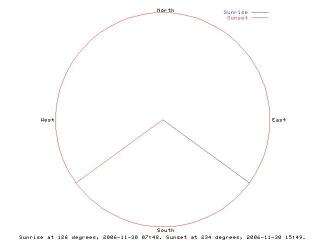
I've updated the my sky section of my main site to include a couple of daylight graphs. The first one graphs the rise and set positions of the Sun for the current day:


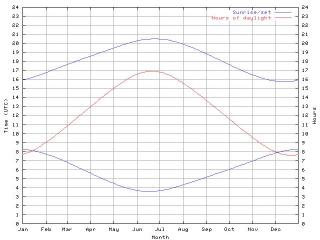
The second graphs sunrise/sunset times and total hours daylight for my location:


And the reason I added them? Well, no good reason really. They are sort of useful for a quick glance but the main reason I added them is because I fancied a quick bit of hacking (and also because I've been playing with compass-a-like graphs on my weather station site).

2006-11-29

Exceptional sketches

Take a look at the two sketches in this thread on the SPA BB.

Wow! Just.... wow!

2006-11-28

Request for images of Cassiopeia taken in October

Via this post on the SPA BB:

The Astro community are calling for images of Cassiopeia taken this October. There was an unusual brightening of a star which might have been a very rare gravitational lensing event. There are plenty of observations after it brightened but only a few before. These would help confirm the shape of the brightness change curve which must be symmetric for a lensing event.
This is in reference to an earlier thread on the BB.

Also see this news item on the BAA's website.

2006-11-26

UK floodlighting petition

Via this post on the SPA BB:

Andrew Abbott has created a petition for the Prime Minister to ban floodlighting of buildings to reduce energy use, carbon dioxide emissions and light pollution.

You can read the petition and add your signature, if you wish, here.

http://petitions.pm.gov.uk/Floodlighting/

Summary of petition...

Floodlighting of buildings is done purely for our own vanity. It is a significant waste of energy.

The Energy Saving Trust is asking us to cut down on our energy use by 20%, yet private companies and government still waste significant amounts of energy on floodlighting buildings. Why should our taxes pay to floodlight government buildings?

The Government must ban the floodlighting of buildings. Even before legislation is introduced, the government could set a lead in this to encourage private owners by switching off the floodlighting of government buildings.

2006-11-24

Space wurzel

Warning: It probably helps if you're British, or, at the very least, know who Colin Pillinger and Kevin Warwick are and, ideally, why they're often the target for jokes (especially the latter — I really miss the KevWatch website).

Via Radio RTFM, Space Wurzel (MP3 file).

Mobile phones, the next big thing in astronomy?

Okay, I'm pushing it a bit with the title of this post, but I am fascinated by the results that people can get with the little cameras you get in mobile phones (or "cell phone" for those in strange parts of the world) these days.

I've used mine in the past to (try and) record sunspots, the Sun itself (although that one's really rubbish), Mars (yes, I know, I'm pushing it a bit there), the Moon, the Moon with Jupiter, a solar eclipse and various forms of atmospheric phenomena. The results have never been that great but I never really expected them to be that great.

That said, if LPOD is anything to go by, some of the better phones seem to give amazing results.

But, for me, none of the above quite match the image in this post on the SPA BB. Sure it's blurred. Sure it's smudged. Sure there's no real detail. But you can instantly tell which planet it is. An identifiable planet, on a mobile phone! How neat is that?

2006-11-22

A bit more documentation

Given that last weekend's sessions introduced a new type of observing to my logs I felt the need to add a new markup item to my logging system. While doing that I realised that I had no definitive list of all the forms of markup that could be used in the notes for a session or an observation.

So, this morning, I created the list in the (still incomplete) documentation for the file format I use. I've also created a page for each type of markup; each page gives a brief description of the purpose of the markup, the syntax of the markup and also gives an example or two of the markup in use.

I'm glad I finally got around to doing this. From now on I won't need to go looking at my source code or old logs to remind myself how a specific markup item works.

2006-11-21

More time stats

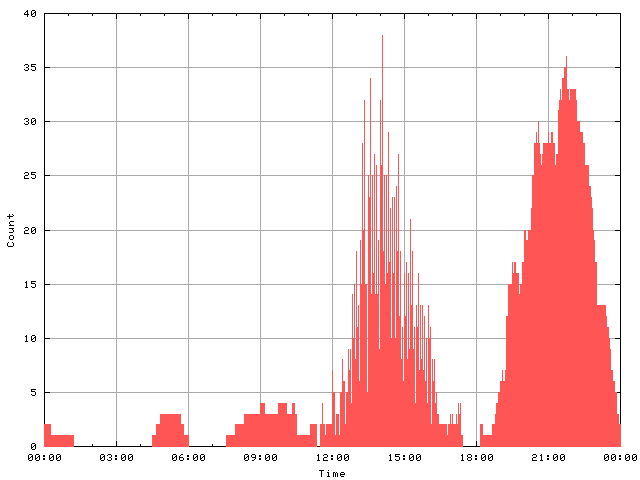
After adding the time stats to my stats page earlier to day I realised that I now had most of the tools in place to figure out which part of the day was most "popular" in my logs. I decided that it called for a nice little graph:


From this I deduce I'm not the sort of person who likes to observe during the early hours of the morning. ;)

Time stats

This morning I made a quick addition to the code that manages my observing logs and added some code that extracts the elapsed times for all my sessions. Using this I've been able to add a new section to my stats page that lists some time-based values.

As of now, since 2005-04-16, I've spent 93 hours doing something related to observing. On average I've spent about ½ hour per session. My shortest session is 1 minute long and my longest is 252 minutes long (although the the longest session is a little misleading because there was a break of about 1 hour during it).

Gravity 3D

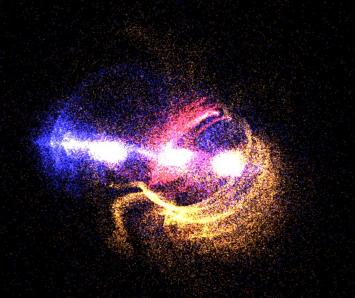
I stumbled on a really nice bit of software this morning called Gravity 3D (sorry, only runs on Microsoft Windows from what I can see). It's a galaxy collision simulator (and it's free). I can't say how "useful" it is in terms of the science but one thing I do know is it's very pretty and very addictive.


The Polygon Worlds site contains other astronomy related software too, including Mars Explorer, Mars 3D, Earth 3D and Venus 3D.

Be sure to have a look in the gallery too.

2006-11-20

Time for a new look

Now that this blog has moved to the new blogger system I've decided to throw away the old template and have a new look. I partly did this so I could make use of the new template management system but I also did it because I fancied a new look anyway.

As far as I can tell the change has gone off without a hitch and I think I've managed to retain all the bits and bobs and links and stuff that I had before.

The layout isn't perfect, there's some changes I'd still like to make, but that's low priority stuff and might not happen for a while.

Let me know if you see any obvious problems.

Leonids: my results

The logs for Saturday morning and Sunday morning are now up.

Here's what I learnt over the weekend:

  • If the outburst did take place I didn't notice it. The numbers of Leonids I saw on Sunday morning pretty much matched with those I saw on Saturday morning.

  • I saw way more Leonids than Ian did.

  • I seem to have seen a similar rate to that seen by Tristram.

  • Planning is a good thing. But when you do plan, try and pay attention to what you're doing.

  • When you do mess up in your planning, try and come up with a really good explanation for it. Hence...

  • When trying to observe a meteor shower outburst, try and have a session 24 hours before hand so that you've established a baseline for the following morning's observation. If you don't it's just really bad science. Okay? (I almost typed that with a straight face)

  • Putting a sleeping bag on the chair and then sitting on the sleeping bag keeps you so much warmer.

  • When you're sat out in the cold, at stupid-o-clock in the morning, looking at the sky and waiting for something to happen, it's impossible not to start thinking that you should take up a saner hobby.

  • The thinking in the previous point totally disappears the moment you see the first meteor.

  • Shouting "Woah! did you see that one!" makes no sense at all when you're the only person sat in your garden at 5 in the morning.

  • You'll never, ever, convince other people that sitting in the cold at stupid-o-clock on a Sunday morning isn't insane.

  • Drinking over ½ a bottle of wine the night before might ensure that you get off to sleep nice and quickly, but it doesn't make waking up any easier.
Can't wait for the Geminids.

2006-11-19

Leonids redux

Following on from yesterday morning's "accidental" session I managed to get out again this morning to try again for the predicted outburst.

The sky wasn't quite so good this morning, ever so slightly misty and when I first went out there was some thin cloud to the west (which did clear after a while). I was also quite a bit colder this morning — just below 0°C.

As for the outburst? If there was one I think I missed it. I started out around 04:30UT and didn't move until around 05:30UT. In that time I counted 7 Leonids. By 05:30UT I was feeling cold and tired (two early mornings on the trot, I'm going to regret this) so I started to pack up. While in the process of packing up I saw 2 more meteors, both Leonids. One of them was probably the best one I saw for the whole of this session.

I'd like to have carried on observing right up until the sky getting too light but I just couldn't stick with it all the way this morning.

I hope the outburst did take place and that the time was off. Hopefully someone out there had a pretty good show.

As with yesterday the session log isn't up on my site yet. I expect to get this weekend's logs typed up some time on Monday.

2006-11-18

Talking of meteors and radio astronomy...

Talking of meteors and radio astronomy... If anyone is interested in this subject and doesn't know much about it this post over on the SPA BB has some interesting links.

The Leonids (and a silly mistake)

Despite what I said yesterday evening, I did get to do some Leonids observing after all.

Late on last night I caught the forecast on the BBC and it said that things would clear up around midnight or so and stay clear into the morning. I then recalled having read an article in the November issue of Sky & Telescope about a predicted burst in activity set for around 04:45UT on the 19th (those quick off the mark will have noticed a problem already).

So, excited at the prospect of getting some meteor observing in and also excited at the prospect of observing a possible outburst of activity, I set my alarm for 04:10.

Despite some reluctance to get out of bed I was finally out and settled by 04:39 and stayed out until 06:00 (by then the sky was starting to get light and the cold was starting to get to me). I had quite an enjoyable time. I counted 9 Leonids in total. I also saw 2 sporadics and quite a few satellites.

And now for the silly mistake (you've seen it already, right?): I came into the office to warm up and to make this entry and then I realised the date. It's the 18th, not the 19th. I went to all the effort of getting out really early to try and observe an event that wouldn't be happening for another 24 hours!

I feel like a total idiot. A cold, over-dressed (hat, two coats, two t-shirts, jumper, two scarves, two pairs of socks, etc...) but very satisfied idiot. But I still feel like a total idiot.

That said, at least I got out and managed to observe something. The weather wasn't good late into the night last night and the forecast isn't that promising for tonight and early tomorrow morning (although, if it changes, and I'm up to it, I might try this again tomorrow).

The session log isn't up yet, I'll be typing that up in the next couple of days.

2006-11-17

Megan is back!

Yay! Megan is back! And with a fascinating post too.

I really should have a go at this business of listening to meteor showers. I've being looking forward to the chance to observe a shower but, ever since I got back into observing, I've always had pretty bad luck with the weather. The same looks true for the Leonids this month — it's raining right now, has been raining for most of the day and the forecast for tonight is more rain. Tomorrow night looks like it'll be cloudy.

On the move, sort of

This afternoon I decided to make the move from the classic blogger system to the new beta system. For a short while there I thought it might have all gone horribly wrong but, thankfully, it all seems to have worked in the end.

However, given that this is a beta system... In other words, if something odd happens to this blog, if it goes missing or something, you know why.

In the event that anything does happen I'll try and ensure that some sort of note is placed on the front page of my main site.

One plus point: the new system appears to support the labelling of posts so I can finally do away with my old "file under" system (which was simply a set of pointers into Google's blog search engine).

2006-11-12

Lunar mystery part II

Back in July I wrote about a little Lunar mystery that had turned up on the SPA BB. It seems that the mystery hasn't been fully resolved yet.

Geoff is still trying to clear up what it was he observed and he now has an observing plan in place to try and reproduce the situation. He's posted a list of dates and times when conditions should be the same as his original observation and is hoping that a few other people might be able to join in and help.

I thought I'd mention in case anyone reading might like to join in and also because not all the times listed are practical for UK observers — perhaps someone over the other side of the pond (for example) might like to join in to cover those times when most UK observers would be fast asleep?

2006-10-31

A future for Hubble?

The Bad Astronomer is reporting that the Hubble servicing mission is go.

Yes!

2006-10-29

More comet M4 Swan

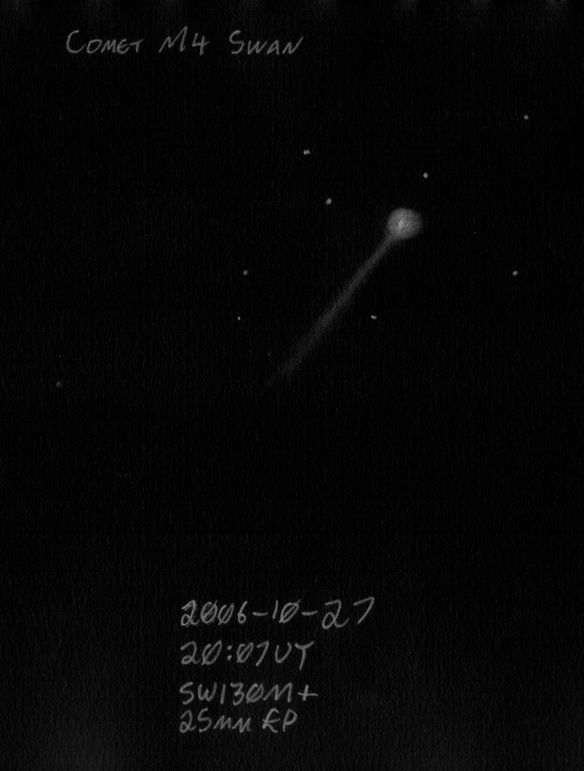
Last Friday night was another clear night so I managed to get out and view comet M4 Swan again. This time I got the 130M out to observe with and was rewarded with a pretty good view. I even had the time to attempt a little sketch too:


The full log of the observing session is available online.

2006-10-27

You could fill a book... Part II

Something I forgot to mention in my previous entry is the fact that last night's session saw me filling my second log book — it's taken since since January this year to do that.

Just another little arbitrary milestone that's worth remembering...

File Under: Logbooks, Milestones, Amateur Astronomy.

Comet M4 Swan

I had another clear night last night (it's so nice to be getting out and observing at night again, especially at a reasonable hour) so I made a point of heading out to see if I could catch Comet M4 Swan. I managed to find it without any problems and had a pretty good session observing it, the full text of the log for the session is now online.


It's at times like this that I wish I had some sort of imaging equipment. Given that I don't I can console myself with Pete Lawrence's excellent images and those that can be found in the SpaceWeather gallery.

File Under: Comet, Comet M4 Swan.

2006-10-25

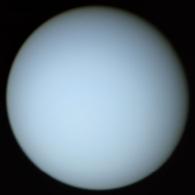
Uranus

Last night was a first for me. For the first time ever I knowingly observed Uranus. The details of the observation can be found in my online log.

It was an interesting experience too. Unlike observing the likes of Venus, Mars, Jupiter and Saturn this required a bit of preparation and plenty of checking and double checking during the session. Also, given the nature of my equipment (I first used 10x50 binoculars and then followed up with the Antares 905), the view itself was never going to be as rewarding as most of the other planets so I found that, in this case, the real enjoyment came from finding the planet and then spending time ensuring I'd really found it.

After having found it, and after spending some time observing, I found myself thinking of a particular house in Bath, back in 1781, when William Herschel will have first realised that he'd discovered something important.

Sometimes, in this hobby, the view isn't the reward, it's the chase and the thoughts it triggers.

File Under: Uranus, William Herschel.

2006-10-18

I'll never complain again...

Via Astronomy Magazine, reporting on the earthquake in Hawaii :

The observatories atop Mauna Kea didn't escape entirely unscathed. The W. M. Keck Observatory, whose twin 10-meter telescopes are the world's largest, canceled all observing through Wednesday night. Some guiding and pointing systems were affected and must be repaired before observing resumes. Technicians reported yesterday that the primary mirrors of both Keck telescopes appear undamaged.
Okay, that does it, never again will I complain about having to collimate my 'scope.

File Under: Mauna Kea, Hawaii.

2006-10-10

Royal Society Journal Archives

A friend has just pointed out to me that the Royal Society have opened their journal archives for free access (I'm told this will last until December).

So, anyone out there interested in a letter from someone called Mr Newton, going on about something to do with optics...

File Under: Royal Society, Isaac Newton.

2006-10-06

SPA Convention 2007

I noticed something good in the forthcoming events section on the SPA home page the other day:

March 10, 2007. SPA Convention 2007, Institute of Astronomy, Cambridge. Details of the main speakers to be confirmed.
Excellent! I really enjoyed the first convention in 2005 so I'm really looking forward to this!

File Under: Society for Popular Astronomy, Astronomy Events.

2006-09-26

Here comes the wedge...

First off, an apology. Normally I'd have placed a post such as this in my personal weblog but given the subject in question, and given how we've seen in the US that astronomy can be one of the next targets for this sort of thing, and given that one or two readers of this weblog are involved in science outreach in the UK, I thought it worth a mention — if only so I know that they're aware of this happening.

It would appear that the wedge strategy has finally found a firm foothold here in the UK. Yesterday Tim Haynes was kind enough to alert me to this article:

Creationists and anti-evolutionists in the United Kingdom have established a new website, called ‘Truth in Science’, to try to persuade school parents to lobby for their ideas within the British education system.

The move is the latest attempt by opponents of Darwinian theory to ‘teach the controversy’ by claiming equivalence for non-scientific theories of origins often derived from fundamentalist interpretations of Christian scripture.

[Read More]
The site in question can be found over here.

I've not had the chance to have a proper read of it yet but the little I've seen so far bothers me and bothers me a lot — one reason being that my son just started school the other week. It's bad enough that he's only been there a couple of weeks and, already, he's been press-ganged into one religious performance. Given the current laws about education in the UK that's almost excusable (in regard to the school), but I fear for his education in general when I see that the "intelligent design" brigade are now pushing hard to have their nonsense presented as an equal scientific theory in UK schools.

All that said, I'm glad that the website exists — this way it should be easier to keep tabs on what they're attempting to do.

Was there ever a better time for Richard Dawkins to launch a foundation and an associated website? Not to mention release a new book.

File Under: Truth in Science, Intelligent Design, Creationism, Education.

2006-09-25

Mark Smith on the move

A heads up for anyone who used to read Mark Smith's astronomy weblog:

Due to problems with Blogger (they appear to have totally lost his weblog and have not answered a single query he's sent to them) Mark's had to start again. You can find his new weblog at http://marksmith-1986.blogspot.com/.

His isn't the only astronomy weblog I've noticed go missing recently. Daily Planet seems to have gone AWOL as well.

I'm also finding that Blogger is becoming increasingly flaky (publishing seems to be a hit-and-miss affair) and I've been giving serious thought to hosting my weblogs over on the same server as my main sites. In some ways it would be a shame to have to do this, this blog is linked to from quite a few places and appears to have got a reasonable Google PageRank — I don't relish the idea of having to try and build all of that up again from scratch.

And, of course, there's all the hassle of trying to get the content over...

File Under: Blogger.

2006-09-09

Sundogs and Circumzenithal Arc

Late this afternoon I was treated to a rather nice display of a circumzenithal arc and a pair of sundogs. Using a little digital camera I tried to get a few images (the full set of images can be found over here):


File Under: Sundogs, Circumzenithal Arc.

2006-09-08

A rare event

Last night was a very rare event: a significant astronomical event, visible from the UK, and I wasn't clouded out.

After a very cloudy afternoon it cleared up really well in the evening so everything was on for a view of the partial lunar eclipse. Given that there was no way I'd be able to see the rising full Moon from my own garden I walked to the east side of the village to get a view out over Billingborough Fen. When I got there I had a perfect view of the eclipse around maximum phase:


I don't really have anything by way of imaging equipment but I did attempt a couple of shots using a little digital camera that I've recently acquired. Unsurprisingly most of the shots didn't come out at all well (hand held, full optical and digital zoom — it was never really going to work was it?) but at least one or two give a hint of what the Moon looked like:


I stayed in my observing location, watching unaided and with a 10x50 binocular while making various notes, right up until I could no longer make out the umbra of the Earth's shadow (around 19:44UT).

Given that I've managed to do hardly any observing this summer (other than solar observing) it was really nice to be out and observing in the dark again.

File Under: Moon, Eclipse, Lunar Eclipse.

2006-09-06

Planet Astronomy

On and off, this year, I've been toying with the idea of creating a "Planet" site for astronomy related blogs. As usual with this sort of "neat idea" (you know the sort of thing, you probably have a dozen a day too) I filed it away somewhere in my head, on a "I'll do that one day, no, really, I will" TODO list.

This morning, while checking the weblog stats for www.astronomer.me.uk, I noticed a new referrer in the referrer list: www.planet-astronomy.org. Looks like someone's saved me a job and have been kind enough to include this little blog in the list of feeds!

Whoever you are, if you're reading this, thanks! That's a handy resource!

File Under: Weblogs, Astronomy, Planet, Planet Astronomy.

2006-09-04

A holiday with a little bit of astronomy

Last week I was away for a few days holiday, first a few days staying in Whitby and then a couple of nights camping in Teesdale (staying at Highside Farm if anyone is looking for a good campsite in that part of the UK — great location and very friendly and helpful owners).

Before we set off I had a serious think about packing the Antares 905 but, given that the forecast wasn't looking too good and given that I wasn't that happy with the idea of keeping it in a hotel room for 4 nights, I decided against it. Instead I packed a tripod, L-mount and a 10x50 binocular.

The forecast turned out to be about right and during the whole week there wasn't a single reasonable clear night.

I did, however, manage to have some astronomy-related moments.

On the evening of the first full day in Whitby, at the top of the west cliff, I saw a chap putting out some signs for a star party later that evening. The society running it was the Whitby and District Astronomical Society. Even though the weather didn't look at all promising I couldn't ignore the fact that there was an AS event almost on the doorstep of my hotel. Later on in the evening I went along and had a chat with the chap running the event (sadly I forgot to take a note of his name). Normally, if the weather is good, they have a few members and many 'scopes at such an event but that evening they'd decided to keep it small.

Although I didn't get to look through anything (pretty much constant cloud) I did get to have a look at the equipment available and had a good chat about the problems and rewards of running an astronomical society.
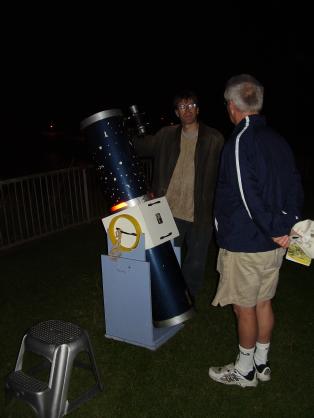
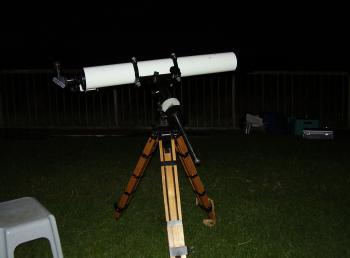
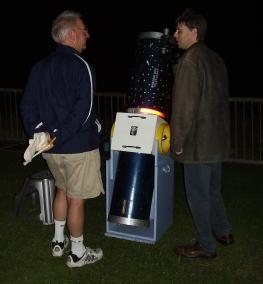


The weather was a little better the following night (mostly cloudy with some reasonable gaps) so another small gathering was held and I went down again. This time it was fun to have a chat with some children who had come along with their parents to have a look at (and through) the telescopes — they also all seemed very keen to demonstrate their great understanding of astronomy my telling me that there were only eight planets in the solar system. ;)

The couple of nights spent in Teesdale passed without any clear skies at night (but lots of rain) so I didn't even manage to get the binocular out. That was a bit of a shame really given that the views looked like they might be quite good from Highside Farm.

After Teesdale it was back home and then, last Saturday, off to The National Space Center for a British Astronomical Society out-of-London meeting (dragging Bob D'Mellow along with me — he'd twisted my arm to go camping so it only seemed fair that I try and push him into astronomy a bit more <grin>); the subject for the day was Birth & Death of Stars and the Bits In-between. It was a really enjoyable day with some very enthralling talks. Given that I've recently got into some (simple) solar observing I especially appreciated the talks given by Alice Courvoisier (The Magnetic Sun), James Wild (Aurora Watch & the UK Sub-Auroral Magnetometer Network) and Graham Vernier (BiSON — Birmingham Solar Oscillation Network).

I was also very impressed with the talk given by Dr Darren Baskill (The Evolution of Cataclysmic Binaries). While the talk as a whole was very interesting (and it's rekindled a desire I've had for a while to get into observing variables) the thing that impressed me the most was his open and honest discussion about the fact that he'd done many years research on a theory regarding a particular problem with the periods of cataclysmic binaries and how, recently, all that work has been thrown into doubt. While some people might view this as a failure I (and Bob, who was with me, shared this view) saw this as a great example of science doing what science can do best: being honest about results and documenting intriguing mysteries. Even better was the fact that I got to have a brief chat with him later and he was more than happy to answer (what must have seemed to be) my rather simplistic questions. That sort of patience and desire to help never ceases to impress me.

The only real downer during the whole day (other than the less-than-ideal room with its really uncomfortable seats — give me a proper lecture hall any day) was the fact that we'd all been given free tickets for the Space Center itself but, by the time the day finished, last entry was a couple of hours in the past. Although I've been a couple of times in the last two years a quick whiz round would have been nice.

So, a week without any form of observing at all, but at least I managed to get some astronomy-related activities done.

File Under: Whitby, Teesdale, National Space Center, British Astronomical Association, BiSON.