2007-10-02

Battlestar Galactica

I adore the new take on Battlestar Galactica. No kidding, I think it's one of the best, if not the best, SciFi TV series ever made.

Really, it's not just good, it's very good. Amazingly good. So good I don't know how to actually say how good it is.

In other words, I quite like it.

It's the start of a new month. Often, at the start of a new month, when I look at the monthly stats for my websites, I'll find forums out there who are hot linking to images that I host. This annoys me (mostly because the person who has done this is, in effect, "stealing" bandwidth) and I generally go and do something about it. I do, however, try and make a point of seeing what's going on first.

Now you're wondering what this has to do with BSG. Well, last night, I was checking the stats for my astronomy site and I saw some hits from the forums on SciFi.com (before now I don't think I knew they had any, but it makes sense). Thinking that it might be someone hot-linking I went to have a look.

I found that the links came from this thread. Seems that a bunch of people are geeking out over where the colonial fleet are "currently" located. Someone had even gone to the trouble of trying and find a map or two that relates to a chart that is seen in one of the episodes. And this is where the two things link up: Where do they go to get their chart? Here! :-D

Of course, within the universe of the show, there are massive problems with that. As someone in the thread points out:

This makes finding where they are even trickier... Unless the colonies were in OUR SOLAR SYSTEM, there's no way that they could possibly have the same star maps...unless the prop department just grabbed a bunch of star charts (which since they were two dimensional ground perspective maps would be virtually useless in interstellar navigation...) and told the actor to "point there"... Which once again worries me that the writers have no idea where they are...
(which had me laughing out loud for a number of reasons — props? They use props!?! On a TV show!?!?! <g>).

So, yeah, I got a bit of a kick out of that. A bunch of people geeking out over the finer points of a SciFi TV show (which I totally get, I totally get the geeking out thing) and they've done so while referring to something on one of my sites.

In my little geeky world I find that cool. ;-)

2007-09-12

Google Sky Paper

Via Ogle Earth, the authors of Google Sky have a paper about Google Sky on arxiv:

Astronomy began as a visual science, first through careful observations of the sky using either an eyepiece or the naked eye, then on to the preservation of those images with photographic media and finally the digital encoding of that information via CCDs. This last step has enabled astronomy to move into a fully automated era -- where data is recorded, analyzed and interpreted often without any direct visual inspection. Sky in Google Earth completes that circle by providing an intuitive visual interface to some of the largest astronomical imaging surveys covering the full sky. By streaming imagery, catalogs, time domain data, and ancillary information directly to a user, Sky can provide the general public as well as professional and amateur astronomers alike with a wealth of information for use in education and research. We provide here a brief introduction to Sky in Google Earth, focusing on its extensible environment, how it may be integrated into the research process and how it can bring astronomical research to a broader community. With an open interface available on Linux, Mac OS X and Windows, applications developed within Sky are accessible not just within the Google framework but through any visual browser that supports the Keyhole Markup Language. We present Sky as the embodiment of a virtual telescope.
I suspect this might be the first paper I've ever seen on arxiv that I actually stand a chance of reading and understanding. ;-)

2007-09-07

LovellCam for iGoogle

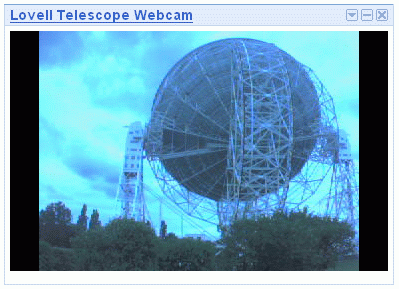
Sort of following on from Astronomy on Your Google Homepage and More Astronomy on Your Google Homepage, how about a Lovell Telescope Camera on your Google Homepage (although, these days, it's called iGoogle):


If you use iGoogle and want to give it a spin just add this to your home page.

2007-09-04

A plan for more openness

I like where Stuart is going with this.

Contrails: Not always a bad thing

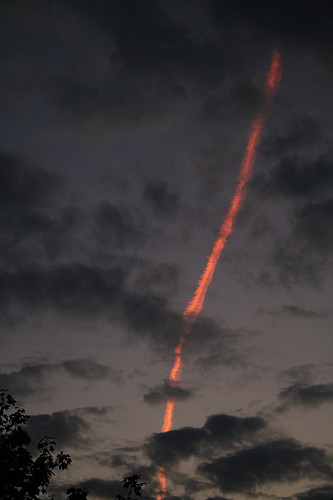
Well, when I say "not always a bad thing", I don't really mean it. Of course they're a bad thing for most observers. But, sometimes, just sometimes, a contrail can put on a really nice display:


Sunset Contrail

Almost a poor man's noctilucent cloud.

Horizons in Google Sky

Just recently I got an email from Ryan Scranton, one of the developers involved with Google Sky. He was replying in relation to what Google Sky is, what it does, and what other people would like it to do (by the looks of things the point of the product does appear to be that it should be a platform on which other things can be built rather than it trying to be yet another planetarium).

One complaint about the product appears to have been the lack of a horizon. This isn't something that bothers me, I'd go use a planetarium if I wanted that, but it also appeared reasonable to assume that someone out there would come up with something akin to that at some point soon.

And then Ryan pointed me in the direction of Hey, What's That? (actually he pointed me at this blog entry on Ogle Earth). Stand alone that's a pretty neat application. I can imagine using it to try and figure out what I'm seeing in a landscape photograph, for example (well, okay, perhaps not a Lincolnshire landscape, it's a bit flat around here — perhaps for Scottish landscapes then? <g>).

But, here's the clever bit: the site also has the ability to export an actual horizon for an actual location and let you use it in Google Sky. Now, I'll be the first to admit that it's not as pretty as the view you get in something such as Stellarium, all you get is a grid for the sky and a line that marks the horizon (lumps and bumps and all), but for those who hanker after such a facility in Google Sky, it's a start. I think it's a really nice example of Google Sky providing a platform on which other people can build handy tools and applications. It seems to be a nice illustration of what I was saying the other week.

On the wider issue of what Google Sky does and doesn't provide: I'm told that the people behind it are reading what people are saying and they are very interested in the thoughts and ideas that people have been expressing. They also seem surprised (in a good way) that it's had so much attention and people have been checking out all sorts of details (and finding interesting little quirks).

So, if you've got ideas for what's missing, what's good, what could be better, would would be a nice addition, etc... post away.

Feel free to post them as comments here if you like.

2007-08-28

Google Sky: Microwaves

I've just been having a quick play with this KML file for Google Sky. It's the data from the WMAP mission, put together so that it overlays the sky (although the "Earth, Sky, there's no difference" quirk does mean that it can also appear as a "skin" for the Earth — which looks kind of odd).

I'm finding that having that image overlaid on the sky, especially when I dial down the transparency, is really helpful in understanding what some of the "hot spots" (for want of a better phrase?) really are.

2007-08-24

SIMBAD, ruby, and a little bit of hacking

Caution: Contains geekness

Following Al's suggestion in a comment yesterday, I decided to take a look at the name resolver web service. Never having worked with this sort of stuff before it took a little bit of reading (even more so since perl and me fell out a long time ago so I tend to use ruby when messing about with script-like stuff) but I finally got something up and running.

I've knocked together a very simply test script called aresolve. The only point of it is to take a name of something on the command line and print some information about it (in this case the RA/Dec and all aliases).

And it works:

davep@hagbard:~/temp$ ./aresolve M45
RA...: 56.8500000
Dec..: +24.1166667
Alias: M 45
Alias: C 0344+239
Alias: Cl Melotte 22
Alias: H 0346+24
Alias: [KPR2004b] 47
Alias: NAME PLEIADES
Alias: NAME SEVEN SISTERS
Alias: OCl 421.0


Sweet!

Yes, I know, to those who do this sort of stuff every day it's probably no big deal but, well, you know, when you try something yourself for the first time...

So, thanks to Al, I've got a solution. Now to go find a problem...

2007-08-23

Straw Scope

Via this Jodrell Bank twitter

The @LovellTelescope has been recreated in straw near Nantwich: http://www.snugburys.co.uk/sculpture.htm
How totally pointless and amazingly cool is that?

More Google Sky

Yes, yes, I know, Google Sky is so yesterday...

Continuing on with the theme of the point and purpose of Google Sky, I see that even Phil Plait has taken the easy route to reviewing it and decided that it isn't as good as some venerable planetarium software. Well dur!

Like I said yesterday, I think it's missing the point to look at Google Sky like that. This is how you should look at Google Sky:

I've spent the afternoon poking around with the internals of the VOEvent broker and the KML documentation and I currently have a live network link (KML) connected to the broker. This means that any OGLE, Robonet-1.0, ESSENCE, SDSS, GCN or other event messages that flow across the backbone will be automatically published to Google Sky.
See where this is heading? See that it's about data and information sharing? See how it's not about trying to be yet another bloody planetarium?

The two big problems I see with the whole Google Sky approach at the moment are this: First, there's no online version. By that I mean there's no sky.google.com in the same way we've got maps.google.com. I think that's a serious downer. Providing a way of embedding maps into other sites is seriously useful and I think it's one of the really big wins of the whole Google Maps/Earth arena.

The second big problem I see at the moment is that, with Google Sky, the only extension service that appears to be available is via KML. What I've not yet seen in the documentation is any hint of any ability to "search" and find things as part of some presentation. If that doesn't make sense, consider an example:

Suppose I wanted to knock up a layer that presents my observing logs. As it happens, I don't record the RA/Dec of the objects I observe, ever. What I do record are names and IDs of such objects. So, for example, I know all the times that I've observed M13. To create a KML for Google Sky I need a way of converting "M13" into RA/Dec. From what I've seen of the documentation so far there's no obvious way of doing this.

Over in the Google Maps/Earth arena, this problem is covered. There's ways of, for example, turning a postal code into a lat/lon. So, in the Google universe, is there or will there be an API for turning Messier IDs or NGCs into positions in the sky? And, if not, why not?

All of which brings me to the point that does disappoint me about Google Sky. There's a project out that that has been addressing the above issues and has been doing it for some time. I first noticed it late last year. It's Sky-Map.org.

Now, at this point, I was going to point to a couple of examples of how you can do handy little things with the Sky-Map.org API, how it has the astronomical equivalent of the post code lookup facilities I was talking about above. Problem is, while Sky-Map.org itself seems to be up and running, the documentation for the API appears to have gone AWOL.

That aside though, let me give one example of how I do currently use Sky-Map and how I use it in a way that, from what I've seen of the documentation so far, you can't use Google Sky. In the markup I use for my observing logs I have a way of marking up a star. When I generate XHTML from that XML I simply turn that markup into a URL that takes the reader to Sky-Map.org, to the location of that star, and I don't even need to worry about the location of the star because Sky-Map.org does it for me. I only need use:

http://www.sky-map.org/?object=<star name>

For example:

http://www.sky-map.org/?object=TYC5575-473-1

This is the sort of stuff I need to make Google Sky useful. I don't care how badly it isn't Stellarium, Stellarium does a pretty good job of being Stellarium.

I want it to be like Sky-Map.org, with bells on, and other things I didn't know I needed.

2007-08-22

The point of Google Sky

Over on Twitter James of Backyard Sketches says this after trying out Google Sky:

closing the new version of google earth as I have already paid good money for stuff that does it better
I might be reading him wrong but I get the impression that he's not overly impressed by it. But, given the comment, I think he might be missing the point slightly.

Astrogeek says more or less the same thing:
As a tool that introduces some basic astronomy concepts, it’s cool. However, as a tool for use by anything more than the greenest amateur it falls short.
While it's obvious that Google Sky isn't (currently?) up to competing with much of the planetarium software that most amateur astronomers use (Stellarium, Starry Night, XEphem, Cartes du Ciel, etc...) I doubt that's really the point of it. As I see it, the one important thing that Google Sky offers is a common meeting ground for lots of little projects that people have yet to think up.

We've seen this with Google Maps, Google Earth and lots of other Google projects. The thing that Google tends to deliver best is an API or some sort of common platform that others can use to create useful things. From where I'm sat it would appear that this is the aim of Google Sky too.

For example, I can imagine that it would be easy enough for a keen astrophotographer to publish their images as a Google Sky layer in much the same way as I've done with my conventional photography. I can imagine Stuart providing a KML feed that works alongside his radio telescope twitter feeds. I can imagine using it as an alternative way of navigating an index of my observing logs. I imagine that there's people out there, right now, hacking on layers I've not even thought of yet (and probably never would).

In other words, it strikes me that if you're interested in sharing information, if you're interested in building and maintaining a community, if you're interested in trying to contribute to the popularisation of amateur astronomy, it's easy enough to see that Google Sky is potentially a very useful (cross platform) interface in which interesting things can be built.

I can't help but think that quickly looking at it and seeing that it's not as rich as some of the existing planetarium software is missing the point.

Google Sky: It's "Official"

Finally Google have a page up for Google Sky.

The intro video is a bit cheesy:


At least the demo video isn't quite so bad:

Google Sky: A new star cluster is found

I've had another quick play with Google Sky and just noticed something slightly amusing.

Back in January this year, while following a friend's lead, I added a Google Earth feed to my gallery of photographs. It's nothing that clever, it simply adds a little icon to places I've taken photographs at and you can click through to see each album.
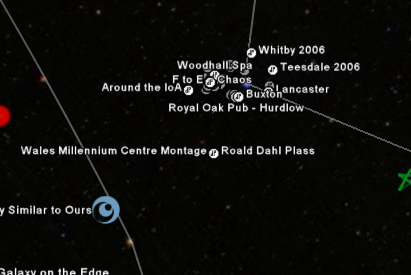
I've got that feed enabled in my copy of Google Earth.

So, there I am, scanning around the sky, seeing what there is to see inside Google Sky itself, and I notice lots of little white dots. Not stars, but tiny little while icons, different from the coloured ones I'd noticed earlier on. I click on one and it splits apart into a handful of little white icons (the usual thing that Google Earth does if multiple items exist in the same place).

So I zoom in, and suddenly I realise what it is I'm seeing:


It seems that the feed for my photographs is still live when in sky mode. It's not obvious to me if this is a bug with my feed, or a bug with Google Earth/Sky. What I do know is that if I turn on the feed from my Panoramio photographs (to use a different example) I see the same effect (although I get thumbnails from there, not my own icon, obviously).

Google Sky: First 5mins

Given that I still couldn't see any mention of Google Sky on the Google Earth website I decided to update my copy of Google Earth anyway and see if the facility was in there. It was:


A quick click on the button and, instead of looking at the Earth, I'm looking at the sky, with all the obvious constellations and asterisms marked.

The sky is littered with various dots of different colours (red for Messier, Blue for NGC, blueish swirl things for Hubblesite), when you click on them you get the usual Google Earth pop-up bubble thing with information about an object at that location.

As you'd also expect: pick a DSO, zoom in, and Google Earth downloads nice pretty pictures for that item.

Well, that's it for the first 5min play. It's pretty much what I expected it to be. I can't imagine that I'll be dropping my use of Starry Night for this any time soon, but I can imagine that this will be useful for other purposes. The first thing I want to look at is what's required for a KML file that can be used in Sky mode — I can imagine using this for a few things (and I bet Stuart will be looking into that pretty soon too).

Google Sky

By the looks of things a Google tool some of us have been waiting for for some time is now available (or, rather, will be later today). I first saw this about ½ hour ago on the BBC TV news. There's also an article on the BBC website:

The constellations of Andromeda, Hydra and Vulpecula are now just a mouse click away for amateur star-gazers, following the launch of Google Sky.

The tool is an add-on to Google Earth, a program that allows users to search a 3D rendition of our planet's surface.

Sky will allow astronomers a chance to glide through images of more than one million stars and 200 million galaxies.
I've been over to the Google Earth site and can't find any evidence of it at all. I'm sure we were told a URL in the interview I saw with Ed Parsons but the URL, as I recall it, doesn't work. Then again I think he said something about Google Sky being released "later today". So I'm guessing that we're supposed to wait for the US to wake up first?

Doubtless the "heavyweight" astronomy bloggers (you know who you are ;-)) will be along soon to write more about it (checking my RSS feeds at the moment, nobody I follow has given it a mention so far) but, when I finally figure out what and where, I'll probably chime in too.

2007-08-17

ROG Blog

Thanks to Stuart I see that ROG now has a blog. That's an instant add to my RSS reader of choice.

2007-08-06

Brian May: Astrologer

Ahh, the good old Daily Mail, you can always rely on them to get a story totally wrong. From this story:

Guitarist Brian May was always known as one of the most famous stars of rock, which probably explains why the music legend has now taken up studying astrology.

Brian May, the lead guitarist from the rock group Queen, is gearing up to study an astrology PhD.
In case you've not got it right away, read it again, carefully.

Yes, the good old astronomy/astrology mix-up. Of course, this being the Daily Mail, they wouldn't see why this is a problem.

Best part is, even if they'd said "astronomy" instead of "astrology", they'd still have the story wrong. Far from "gearing up to study" the subject, he's (if I recall correctly) just recently finished and submitted his thesis and will be defending it towards the end of the month.

2007-08-03

Space Signpost

Via this thread on the SPA's BB:

Hi, I’m writing from a small market research firm in Bath. We’ve been commissioned by the Open University to conduct market research into the commercial potential for an educational astronomy-related product that’s under development.

The product is called ‘Space Signpost’, and it’s a desktop gadget that will physically turn and point to the exact location of any astronomical body. Here’s a link to the Space Signpost web site, which shows some of the educational prototypes to date; I can also post a sketch of some of the thinking for potential design of the commercial product, which is a much smaller desktop version, with specific features as yet undetermined.
There's not that much information about it at the moment, although it's an interesting idea if the large-scale versions are anything to go by. I can imagine that it might be a useful prop of you're the sort of person who gives tours of the night sky to groups of people, but I'm struggling to think of a personal use (other than the gadget-value anyway).

My response to the questions can be found here.

2007-08-02

All seems well down at the Zoo

I just received a copy of the first ever Galaxy Zoo newsletter. It opens with this:

To date, unbelievably, 80,000 of you have viewed and classified more than 10 million images of galaxies. Our initial target of having each galaxy (there are a million in our initial sample from the Sloan Digital Sky Survey) viewed once is more than done, but we still need your help. Our NEW target is to have each and every galaxy classified by 20 separate users.
All that and, what, they've been running live for less than a month?

Impressive!

2007-08-01

Hug the Bad Astronomer

Go on, you know you want to.

2007-07-31

Careful With That Saturn V Picture, Eugene...

Via slashdot:

"Get ready to surrender your data sheets, study reports and blueprints of the Saturn V to stay in compliance with ITAR. Armed guards are reportedly taking down and shredding old Saturn V posters from KSC office walls that show rough internal layouts of the vehicle, and a Web site that is a source for various digitized blueprints has been put on notice it may well be next. No word yet if the assignment of a Karl Rove protege high up in NASA has any connection."
This has got to be a joke, right? Tell me it's a joke. The US can't be that stupid, can it?

2007-07-30

Getting More Involved

It's now well over 2 years since I joined the Society for Popular Astronomy and started to get involved, as a user, with their BB.

A little later on in 2005 there was a problem with the SPA website and, more by accident than design, I lent Jeff Stevens a hand with figuring out what had gone wrong. As part of that process I ended up being made an moderator on the BB and then, a short while later, got bumped up to administrator status.

After that I got to helping out with little bits of HTML hacking for the main site and even knocked together a couple of "fun" pages outside of the main content (first was the BB user map and, some time later, the astronomical event timeline).

Recently Jeff has had other demands on his free time and, sadly, found that he needed to step down as the SPA webmaster. It was suggested that I might like to step into the role. Well, I accepted and, as of last Saturday's SPA council meeting, it seems I'm officially an officer of the SPA.

It's quite exciting and daunting all at the same time. It also feels a little odd too. As a child I was a member of the Junior Astronomical Society (as the SPA was called then) and, to a young lad living in York, those grown-ups all the way down in London seemed very remote — now I'm one of them!

Jeff will be a hard act to follow (same goes for Paul Sutherland who was the webmaster before Jeff) and I hope I can manage to serve the society as well as he did.

2007-07-24

Mars "Hoax": That time again?

Ian is reporting that the Mars "hoax" is back again.

That explains something.

This morning I was checking the stats for my astronomy site and I noticed that an old Mars as big as the Moon post had reappeared in the list of referrers. I've not seen that post in my logs for quite some time.

Well, it's almost August again isn't it?

2007-07-23

More mobile phone astrophotography

Anyone who has read this blog for a while now will know that, on occasion, I've had a silly moment and tried to use the camera in a mobile phone to grab images of what I was observing (things like the Sun, Mars, the Moon, the partially eclipsed Moon, Saturn and even the Moon and Saturn together).

I've never had that much success, the images have never been that good (neither has the equipment) and, in each case, it's always been more about being a bit silly than about trying to get a useful image.

However, Ian Musgrave has, to my eyes, managed to capture an astonishingly good image of the Moon with his mobile phone.

Even more astonishing is his image of Jupiter. While the planet itself is devoid of any detail, he's managed to pick up three of Jupiter's moons.

On a mobile phone!

2007-07-19

Zoo Spin

I've just been having a look at the Galaxy Zoo FAQ and saw this:

Q. Why record the rotation of the galaxy when it depends on your position? A different observer on the other side of the galaxy would observe it rotating the opposite way. And shouldn't they all be random?

A. Yes, they should be, but a recent investigation involving 1600 galaxies suggested that the odds of seeing a clockwise or an anticlockwise galaxy changed depending on where you look in the sky. If this is true, it suggests we're missing something about how the Universe is organised on large scales, and so we decided - with your help - to see if the effect is real. We are also interested in the correlation of neighbouring galaxies, for example whether a close pair of galaxies rotate the same way, and all observers would agree on such an observation.
That's a new one on me. How cool is that?

2007-07-16

Population Question

A question to those in the know who might happen to read this weblog:

It's prompted by this thread on a BB I'm a member of, and specifically by something I was thinking about in this particular post. Actually, thinking about it, the question (as I've thought about it) probably goes back around 10 years, back to the days when I used to hang out in uk.rec.ufo (back in the days when usenet was generally fun and usable).

So, here's the background summary (which isn't really the question as such, but gives it some context): Fans of the Extraterrestrial hypothesis, as an explanation for UFO sightings, almost always tend to be of the opinion that the distance problem is a non-problem due to the fact that any visiting race is older than us and, obviously, have solved the problem of travelling at speeds greater than the speed of light.

But why should it be so? Why should we assume that humans are a youthful race in our galaxy (let's keep it simple and just think in terms of our galaxy)? Why can't it be that we're one of the first forms of intelligence to emerge?

This is where I got to thinking about the question I wanted to ask: assuming, for a moment, that life only forms in the vicinity of metal-rich stars (a safe assumption based on the available evidence, right?), this would mean that life would be forming around Population I stars. When I raised this in the thread I mention above someone got to wondering about the relative age of the Sun to other Population I stars. It was then that I realised I didn't know the answer to such a question. It was my understanding that the Sun was about as old as the oldest Population I stars but, when I went and did a little bit of searching, I couldn't find a clear answer.

So, after all that waffle, here's my question to anyone who might know: how old are the oldest known Population I stars, especially in comparison to the Sun? Is the Sun an "elder" member of Population I or is it a more youthful member?

Note that I'm aware of the accepted age of the Sun, and I'm also aware of the accepted life expectancy. It's the age in relation to all known Population I stars that I'm wondering about.

Anyone got any good pointers for an interested layman?

2007-07-10

Astronomy Bloggers and Twitter

It's two months now since I created a Twitter account and made my first post (mainly because of Stuart's rather neat back). Since then I've been trying to hunt down astronomy bloggers and astronomy related people/things on Twitter and adding them to my watch list.

Here's who/what I've got so far:

Anyone got any others? Am I missing a handy little source of instant updates?

2007-07-09

Number 10 Responds

The office of the Prime Minister has given a response to a recent petition regarding light pollution.

I've had a quick scan of the response and, at the moment, I'm unsure if it's a good thing, bad thing or somewhere in the middle. I should probably take a careful look at the content of the response and compare it with the information I can find on the CfDS website.

At the Zoo

I'm registered at the Zoo, how about you?

2007-07-05

Fancy a Trip to the Zoo?

According to Chris Lintott Galaxy Zoo will be going live in less than a week.

It sounds like a pretty interesting idea:

Welcome to GalaxyZoo, the project which harnesses the power of the internet - and your brain - to classify a million galaxies. By taking part, you'll not only be contributing to scientific research, but you'll view parts of the Universe that literally no-one has ever seen before and get a sense of the glorious diversity of galaxies that pepper the sky.
I'm looking forward to seeing how it all works.

2007-06-16

Daylight Occultation of Venus

Next Monday there will be a daylight occultation of Venus by the Moon. Details of the event can be found over on the SPA website.

I hope to try and observe this. Having managed to observe the recent occultation of Saturn I'd love to have another occultation in my observing logs.

However, I foresee two problems with this. The first is that, being a daylight occultation, I'll still be working. I can probably take some time off but I can never be sure if something is going to crop up. The other problem is the weather. According the the Met Office Monday, around here, is going to be cloudy, probably with rain.

For those of you who won't be able to observe this, either due to work, weather or just simply being on the wrong part of the planet: Peter Grego is planning a live webcast of the event if he's lucky enough to have clear skies.

2007-06-06

Blame it on the Moon

According to an article on the BBC website:

Extra police officers are to patrol the streets of Brighton on nights when there is a full moon.
This is going to happen after
Insp Andy Parr ... compared crime statistics for Brighton and Hove with lunar graphs to discover the trend.
and, apparently, he thinks he's found one.

It'd be interesting to see what he actually found, especially given that there seems to be a lack of evidence of any real correlation.

From my point of view it's tempting to imagine that more people will hit the streets when the Moon is full thanks to the extra light. And, of course, more people, especially if it's more people with a few drinks inside them, could cause an increase in incidents. But, if that's the case, wouldn't it make more sense to increase policing during many of the weeks around the summer solstice when, in most of the UK anyway, it never really gets that dark anyway?

I do like this bit though (emphasis is mine):
It follows research by the Sussex force which concluded there was a rise in violent incidents when the moon was full - and also on paydays.

2007-06-04

BBC Britain in Pictures

The BBC are currently collecting photographs via a Flickr group for a gallery as part of their How We Built Britain series.

I've submitted a few photographs and have also been enjoying looking at what others have been submitting. However, one thing struck me. There seem to be very few photographs of buildings related to astronomy. I've submitted one of the 36 Inch Telescope at the Institute of Astronomy in Cambridge, and I notice that Tim has submitted one of the Royal Observatory in Edinburgh.

Other than that I've not noticed any others relating to astronomy (it could be that I've just not found them yet).

Anyone out there on Flickr who has images of British buildings that relate to astronomy? Fancy adding to the gallery?

2007-05-30

What keeps the Moon in space?

Over the weekend my 5 year old son asked one of those questions that are so difficult to answer because the question itself is wrong, but also very endearing too. He wanted to know what kept the Moon "in space".

I tried my best to answer the question, but no amount of trying to point out that the question didn't really make sense (in a nice way) made a dent.

Well, this morning, I found the answer.

2007-05-24

Daylight meeting of the Moon and Regulus

Pete Lawrence does it again. This time he observed and photographed a daylight conjunction of the Moon and Regulus.

I'm impressed by and somewhat surprised at the ease with which he managed to find Regulus:

When first looking for Regulus, I was expecting something of a challenge to be able to pick it out. The Moon was the key to the observation because it provided a target to focus on and a reference point in an otherwise featureless blue sky.

As it turned out, Regulus actually appeared quite bright and intense. Using an Astronomik red filter darkened the sky (removed the blue component) and improved the view considerably.
I'm annoyed that I missed this.

2007-05-22

Lunar Occultation of Saturn

Tonight I was lucky enough to observe the lunar occultation of Saturn.

Skies were nice and clear for me when I got the Explorer 130M out at around 18:45 UT. By 18:51 UT (yes, no time to let the 'scope cool down) I had Saturn in the eyepiece. This in itself was a first for me. The Sun was still above the horizon — that's the first time I've observed that planet during the day.

The view kept switching from being very hard to make out to being very clear, sometimes clear enough that I could just about make out the planet's shadow on the rings.

The dark limb of the Moon wasn't visible at all so I had no visual clues as to how long I had to wait. There were a couple of false starts where I thought I could see part of Saturn was missing. And then, suddenly, it was really obvious that the Moon was cutting into the rings.

Sadly I didn't have a stopwatch with me so I had no way of timing how long the event took. It felt like it was over in about 30 seconds. I know I was very surprised at how quickly it all happened. It was all over by 19:06 UT.

And then I had a break. I had about an hour to wait until Saturn emerged.

Fast forward to 20:00 UT and the Moon was lost behind a load of cloud. I could see, towards the western horizon, a gap, but I didn't hold out much hope for it getting into place in time. For a while all I had to look at was:

Waiting for the Moon and Saturn
Click for larger picture

Finally, at around 20:12 UT a gap in the clouds gave me a view of the Moon but, just as quickly, it went again. By 20:13 UT a bigger gap moved into place and, through the 130M, I could already see Saturn. Part of the rings was still behind the Moon and over the next couple or so minutes I watched it fully emerge (Saturn was free of the Moon by 20:14 UT).

I just watched the gap between them widen for the next couple of minutes and, then, in a moment of madness (not the first moment of madness like this), I grabbed my mobile phone and held the camera in it up to the lens of the 'scope. This is what I got:

Moon and Saturn on Mobile Phone
Click for larger picture

Probably the worst occultation picture you'll see over the next few days. Probably the worst occultation picture you've ever seen and will ever see. But, what the hell, it had to be done. :-)

By 20:19 UT it had clouded over again. I left it a short while longer and then, realising that was it, I packed up.

I'm so glad I didn't miss it.

2007-05-21

Moon and Venus Crazy

It seems that lots of people either observed or photographed the Moon along with Venus. Amongst the astronomy blogs I read Ian got a shot despite the clouds, Nick got a shot (along with a shots of an Iridium flare and a pair of sun dogs) and Tim got a couple of images (including one exposed for the Moon's highlights and one exposed for the earthshine).

After doing a search on Flickr it seems that lots of people had a go at photographing this conjunction. The most unusual one I've seen is this one.

Jodrell Bank Featured on Twitter

Congratulations to Jodrell Bank! It seems their twitter page is a featured page over at twitter:


Seems there's a few astronomy related people and things on twitter now (in no particular order):
And, of course, I had to join in too.

And Mercury Too...

I really should prepare myself better before I go out observing.

Paul S, over on the SPA BB, pointed out that I should have captured Mercury along with the Moon and Venus. This is where I should have been prepared, I hadn't even realised that Mercury was visible around that time from that location.

I fired up Starry Night and had a look at where Mercury was and then went back and looked at the photographs I took and, sure enough, in just the right spot, there was faint little Mercury.

Of course, in the photograph I posted yesterday, my unprepared head was occulting the planet.

Have a look at this image. It's a blown-up crop of this:

Venus and Moon
Click image for larger picture

If you look carefully in the bottom right hand corner you'll be able to see Mercury.

So, on Saturday night, not only did I photograph a conjunction, I also managed to photograph an occultation of Mercury too. ;-)

2007-05-20

Venus, Selene and Me

I had a pretty late observing session last night, out with a couple of friends just enjoying the available sights (sadly cloud stopped play in the end).

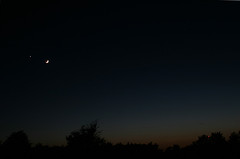
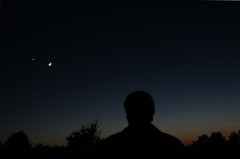
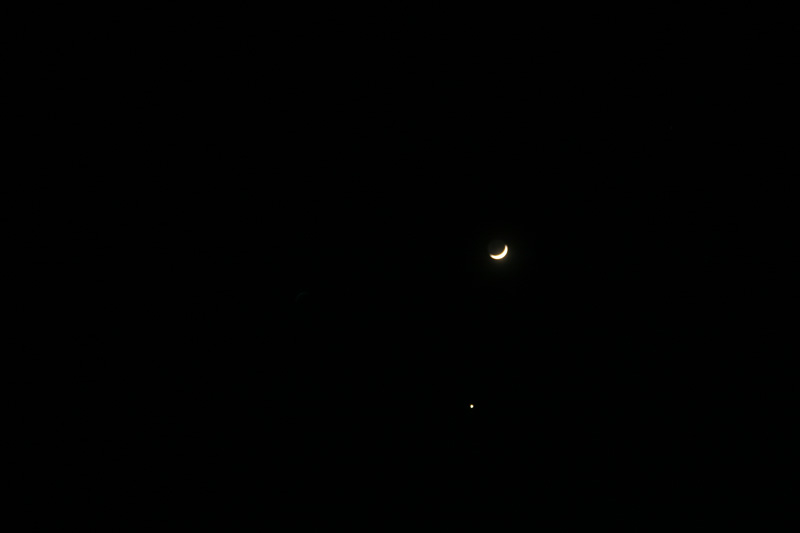
Almost right up until the point where we packed up (around 00:00 UT) the sky had one obvious and striking sight that you just had to keep going back and just looking at. For me nothing quite matches a crescent Moon and Venus. I'm not one for doing much in the way of astrophotography but I had to catch that sight. Not having the gear to do a good close-up (this is the best I could manage) I opted for a landscape shot instead. Actually, more of a landscape and self-portrait:

Venus, Selene and Me
Click image for larger picture

The log of that session should be up in the next day or so.

EDIT: The log is now up.

2007-05-17

A little bit of boasting

I received a copy of the June edition of Astronomy Now in the post yesterday. This one's a little extra special for me. In it there's an article about the 2007 SPA Convention and the two photographs that illustrate the event were taken by..... me! :-)

Yeah, yeah, I know, no big deal. But, as someone who enjoys photography as much as he does astronomy, there's something nice about seeing a "Image: Dave Pearson" accompanying a photograph in a magazine. Especially an astronomy magazine.

Okay, that's enough boasting now. I'll try not to let it happen again...

2007-05-15

In Praise of Clouds

Astronomers hate clouds.

Well, mostly. We generally like clouds on other planets. We sometimes like clouds on our own planet too. But, most of the time, we hate clouds. They get in the way of observing.

But you knew that.

Despite the fact that the weather's been pretty awful lately it's been putting on a pretty good show for me. In the last few days I've seen a nice stormy looking evening and, last night, a very dramatic sunset (which inspired this Hockneyesque montage — sorry about that, I've got a thing about creating montages).

So, the next time you can't observe because it's going to be cloudy, appreciate the clouds.

2007-05-09

Time to move on

When I read this item on the BBC yesterday I guessed it would be all over the astronomy blogs pretty soon although, at the time, I couldn't really see much point in commenting myself. However...

I think the worst aspect of it is that Chris felt the need to go on record and distance himself from the comments (he says "almost all", I'm guessing he agrees with the part that there's a lot of crap on British TV these days but that he disagrees with the posited cause — I'd agree with that too). I'm hoping that there's nobody out there who is stupid enough to think that the bizarre opinions of someone with a history of this sort of thing represent the opinions of everyone involved with a specific TV programme.

Leaving aside Moore's unpalatable opinions and past political aspirations, I do wish he'd retire and hand the rains over to someone like Chris. I'd love to see The Sky at Night fully handed over to some new blood (but please, please, hand it over to someone who is picked for their knowledge of and history in the subject — please don't hand it over to someone because of their celebrity status) and given a regular slot at a reasonable hour. Astronomy, as a hobby and an interest, deserves good publicity and, in the UK at least, probably needs a bit of an overhaul in terms of the perceived stereotype (part of which comes from people such as Moore).

That said, I do wonder if such thoughts are a waste of time, especially given some of the comments made by my fellow members of the SPA.

And then we wonder why there's a stereotype of amateur astronomy based around sad old men with nothing better to do with their time...

2007-05-08

I'm the Gnomon

I spent last weekend in Lancaster. While I was there I took a walk into Williamson Park so I could go and take some photographs of a pretty neat sundial they've got there.

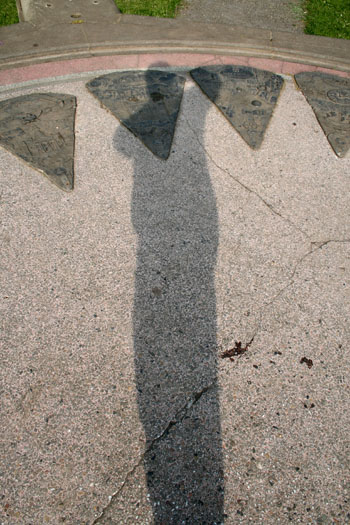
When someone mentions "sundial" most people probably think of the more "traditional" kind of sundial that has a fixed gnomon. The Lancaster Sundial is a little different in that it's an analemmatic sundial and you play the part of the gnomon.


In the middle of the dial is an analemma. To tell the time, and to take the equation of time into account, you pick a spot to stand on depending on the date and then use your shadow to figure out the time (adding an hour if needed depending on daylight saving time).

You can see more images of the sundial in my album of photographs of Lancaster.

2007-05-02

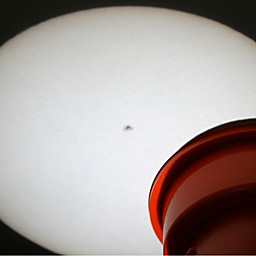
AA 10953 on 2007-05-02

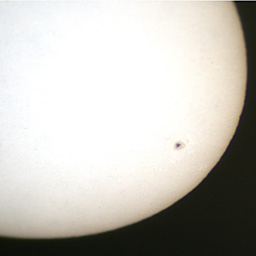
Yet another shot of my view of the sunspot in active area 10953:


As with yesterday I was also able to see the spot with the naked eye via eclipse shades.

2007-05-01

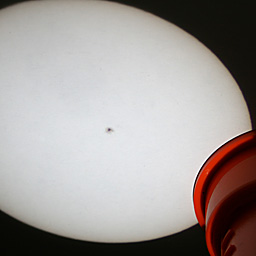
AA 10953 on 2007-05-01

The sunspot in active area 10953 continues to impress after a long period of viewing a blank Sun:


As with yesterday I was also able to see the spot with the naked eye via eclipse shades.

That's great, it starts with an earthquake...

It's been a while since I've seen a "scientists to bring the Universe to an end" story, but a fellow admin on the SPA BB made a post pointing at this vote on the BBC.

Come on, everyone sing along...

2007-04-30

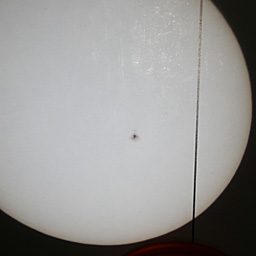
AA 10953 on 2007-04-30

Another shot of the sunspot in active area 10953, taken earlier on today:


I also noticed today that the spot is visible to the naked eye (using eclipse shades, of course).

Flight to the Virgo Cluster

Via this post on the SPA BB: A flight to the Virgo Cluster:

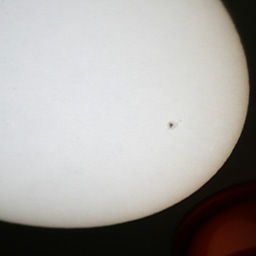
AA 10953 on 2007-04-28

I managed to observe the Sun both days of this last weekend. The spot in active area 10953 continues to look pretty impressive (well, impressive by "we've not had much to look at for a while" standards). I didn't take a photograph on Sunday because conditions were far from ideal but I managed to get this shot on Saturday:

2007-04-27

Randomness

I just had a rather silly idea, and it took no time to implement.

I was thinking that I've got a lot of observing logs now and, to a large degree, I can generally find the one I want (often via the log index). But it might also be fun to have a facility that selects a random logs.

So that's what I did: view a random observing log.

Finally!

During the past couple of months I've had a pretty good run of clear days that have permitted lots of sunspot counts. However, the last time I actually saw a sunspot was 2007-03-03.

That finally changed today:

2007-04-23

Astroblast 2007 - Photographs

I made it to Astroblast and had a really good day out. I don't really have time to write about it at the moment (although I do hope to some time soon) but, meanwhile, here's a gallery of photographs I took while there.

You wouldn't believe the trouble I had to go to to smuggle them out of the event.

2007-04-20

Astroblast 2007

Tomorrow is Astroblast 2007. All being well I'll be going along again.

Looking at the website it appears that it'll be pretty much the same sort of thing as last year which, from my point of view (father with small child), isn't necessarily a bad thing.

Personally I found last year's effort to be quite enjoyable. I read a few negative reviews and most of the complaints seemed to revolve around the issue of it being "a bit lightweight" or "too aimed at children" — which I thought was kind of odd given that it seemed pretty obvious from the website that it was very much aimed at being a family day out with a particular emphasis on children. As someone interested in astronomy, who has a child and a wife who isn't that interested, it's nice to be able to go along to something relating to astronomy with my family and without them being bored stupid (let's be honest, the "hardcore" events have nothing of interest if you're not deeply interested in the subject).

The only complaint that made real sense was about the lack of catering facilities. As I understand it, this year, this won't be a problem (or so I was told by someone on the Greenwitch stand at this year's SPA convention). It's odd, though, that they don't seem to mention this on the Astroblast website.

2007-04-18

The ISS, Leo and Saturn

Tonight I had my first go at photographing the International Space Station.

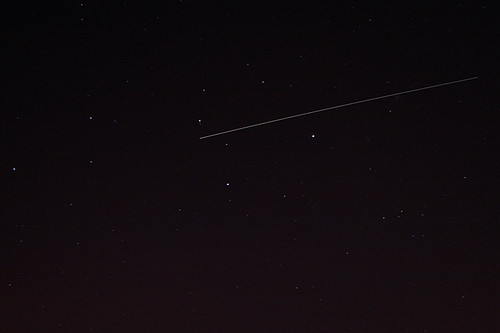
Earlier in the day I saw on Heavens Above that there would be a good pass this evening so I decided to have a go at photographing it. I went out with about 15 minutes to spare and set the Canon EOS 400D up on the tripod and did a few test shots. I had a hell of a time trying to get it focused well but managed to get close to something useful before it was time.

Just as the ISS approached I realised that I had the shutter speed set to 30 seconds rather than bulb and that I'd not yet used the remote in bulb mode and wasn't exactly sure how it worked so, rather than miss the pass, I just went for the 30 second exposure. This is the result:

International Space Station
Click on the picture for a bigger version

That's the jpeg straight off the camera, just with a slight crop, a tweak of the levels and a resize before uploading to my Flickr account.

It's not perfect, but as a first attempt I'm pretty pleased.

Growing up in the Universe

Not exactly astronomy, I know, but I'd imagine that most people reading this will be interested in the following, for more than one reason.

Richard Dawkins' 1991 Royal Institution Christmas Lecture will soon be available to buy on DVD. Earlier on this month a short advert was made available.

Now there's a short excerpt available, and (for me anyway) it's made all the more special because of who appears in it.


I am so going to be buying a copy!

2007-04-04

Saturn and a mobile phone

Sorry about this, but this is yet another one of those "look what I imaged with my mobile phone" posts. I know it's not big, I know it's not clever, but, but, because I can....

This evening I was out observing Venus for a while and then, when Venus got low, I turned to Saturn. What a view! One of the best I've ever had. And, as I have a horrible habit of doing, in a moment of madness I decided to see what I could capture with the mobile phone. This is what I got:


Okay, Damian Peach it isn't, but you can at least tell which planet it is.

2007-04-03

Accidental stereogram

Not exactly astronomy, but it does relate to one of my telescopes...

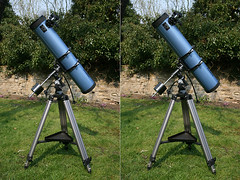
Over the weekend I was taking some new photographs of my two 'scopes to replace those on the tools page of my site (the ones that had been there had been taken with mobile phones and were of terrible quality). While reviewing the shots yesterday I noticed that two of them appeared to be taken from almost exactly the same spot and at exactly the same height.

In other words, I appeared to have accidentally created a stereogram. I then placed them side by side in one image and got this result:

Sky-Watcher Explorer 130M Stereogram

If you're the sort of person who can go cross-eyed without any trouble you should be able to see the 3D effect. Click on the image for a bigger version.

Newton from space

The most recent Google Maps update has seen the addition of lots of new high resolution images for Lincolnshire. Not only have the areas that already had hi-res images been updated, lots of new areas have been added.

So, I was having a look around and seeing what I could see and I noticed that, finally, Woolsthorpe-by-Colsterworth was covered. Because of this it's now finally possible to get a good view of Woolsthorpe Manor. The manor itself is the building in the top left corner of the cluster. If you look carefully in the small field to the left of the cluster of buildings you'll see some of the (in)famous apple trees.

Newton himself is also now visible thanks to this new update. Well, okay, not Newton himself, but if you look carefully you can see the shadow of his statue in Grantham.

Venus

As I noted a few days back, I've finally been observing Venus via a telescope (to the best of my knowledge this year is the first time I've ever done that). The log from the first session can be found here, the second session was a couple of days later.

Two things stand out so far. The first is that these sessions are probably the first time I've noticed filtering making a big difference to a visual image. I've found that, on the 905, a combination of the contrast booster and a 80A medium blue work really well.

The second thing I've noticed is just how tricky a target Venus is. While it's obvious that I've been observing something that has a gibbous phase I've been struck by how indistinct the view is. Of course, this won't be helped by the fact that I'm observing Venus when it's quite low to the horizon – lower than I'd generally observe other planets. It's probably also not helped by the fact that I'm not really using the best 'scope for the job.

But! Will Gater comes to the rescue. His great picture of Venus reminds me an awful lot of the view I've been having of Venus (albeit my view is obviously somewhat smaller than that). It's always nice to have something to compare to and that image really helps.

2007-04-02

A quiet month on the Sun

Going on my records, and keeping in mind the limitations of my equipment, March was a very quiet month for visible solar activity. I managed 20 sunspot counts last month and only saw a sunspot for the first two days of the count. From what I can tell that's the least active month I've observed since I decided to do regular counts starting March last year.

2007-03-29

Close approach of asteroid

Seen over on the BBA website:

Asteroid 2006 VV2 passes close to the Earth at the end of March and the early part of April. At its closest, on March 31, it will be 0.0226 AU away (8.8 lunar distances). This will be the closest known approach by an object this intrinsically bright until May 2036, when binary asteroid (66391) 1999 KW4 (H=16.4) approaches within 6 lunar distances. Observers should be able to see it through modest telescopes as it reaches 10th magnitude on March 31st and April 1st.
That sounds worth keeping in mind and having a hunt for if I'm out and observing at the right sort of time.

Fun Flickr Sunsets

I recently started having a play around with Flickr (and I'm mostly impressed by it; it is a little easier than maintaining my own photo gallery) so when I saw this story on Astronomy Blog this morning it really caught my attention.

How cool is that?

I just love it when the "obvious" is found in "not so obvious" places.

2007-03-26

Venus at Sunset

There was a really nice looking sunset yesterday evening, just a touch of mist, really nice subtle colours in the sky. I just had to grab the camera and head out to the edge of the village and run off a few pictures.

While they don't quite qualify as astrophotography I did make a point of including Venus in some of the shots.

Even better, when I got back home, I noticed that Venus was still visible from my back garden. I immediately got the Antares 905 out and had a session observing the planet. I think this is the first time I've ever observed Venus through a telescope. It's definitely the first time I've observed it via a 'scope since I got back into observing.

2007-03-22

Moon and Venus

I was lucky enough to have some clear skies last night so I went out with the EOS 400D and a tripod and took some photographs of the Moon and Venus together.

As it was they didn't turn out that well, I really need to work on getting the focus right.

I notice that Ian also took some images and also did an animation too. Although, as always, he seems to have managed to photograph everything upside down. ;)

2007-03-20

Star Cards

Last Saturday I was up in York, visiting family. While up there we took a trip to the Castle Museum. There wasn't an awful lot there related to astronomy (there was a display case full of instruments made by T. Cooke & Sons — which included a really nice brass achromatic telescope) but, in the display of children's toys, I did find these rather nice "Star Cards":


Sadly I couldn't see any information about them. I'd love to know who made them and what the story was (and how many there were in a set).

They reminded me of the time when, as a child, I made my own set of constellation cards.

2007-03-15

BAA/CfDS/CPRE star count results

The BAA website now has the results of the December and January star count.

Nearly 2,000 people took part in the star count. Only 2% of people who responded to our online survey said they could see more than 30 stars, compared to 54% who saw fewer than 10 stars in Orion – a level which indicates severe light pollution.
Have a look at the article for a full breakdown of the results (there's also a map of the results too).

Also, don't forget the GLOBE count. I've not had the chance to have a go yet, but time and weather permitting I'm planning on it.

2007-03-12

SPA Convention 2007 - A Short Report

It's been almost a year and a half of waiting but, finally, last Saturday arrived and it was time for the second Society for Popular Astronomy convention.

The day was laid out similar to that of the first convention with various talks during the day, the main talk being The Planet Venus and the Venus Express Mission by Professor Fred Taylor. Alongside all the talks were various stands by the sections of the SPA and also various stalls hosted by a number of vendors of items relating to astronomy.

The doors opened around 09:30 and the main reception area seemed to fill up very quickly – for a short while there was even a queue to get in. Around 10:00, after people had had a chance to get in, get a drink (drink and food was available for sale all day) and have a look around some of the displays and stalls, the bell was rung and people filed into the lecture theatre to hear Dr Ian Crawford deliver the welcome and then hand over to Nik Szymanek for the first talk of the day.

The talk was mostly for beginners and provided plenty of information on how to get started photographing the night sky. Nik also went on to relate some of his experiences photographing from the top of La Palma while showing us some of the results acquired during such trips (including some excellent images of daytime atmospheric phenomena).

A tea break followed and I joined a guided tour of the Thorrowgood and Northumberland telescopes. The Thorrowgood telescope had been set up to track and project the Sun (and, as you'd expect, this happened to be a day with no sunspots visible) while the Northumberland had been set up to track Venus. Sadly, during the tour I was on (there were many such tours available during the day), there was just enough cloud cover to make such an observation impossible.

When I got back from the tour it was time for Nik's second talk of the day, this time an interactive question and answer session dealing with all aspects of astronomical imaging. Given that I'm not that interested in imaging at the moment I decided to skip this and, instead, have a wander around the stalls. I had a chat with Greenwitch — mostly about last year's and this year's Astroblast (the good news is that this time round there will be catering!) – and I also had a good look around the stall run by Astronomica (while there I picked up an affordable 2x barlow to replace the rather terrible one that came with my Explorer 130M – I'm hoping it should do a better job and I'll report on that when I get the chance to try it out).

The next talk was in two parts, the first was about the Terran Planets and was delivered by Michael Hezzlewood; the second part was about observing Saturn and was delivered by Ian Phelps. The talks were slightly delayed due to problems with the projection system and part of the talk was slightly marred by the lack of a microphone (leading to the occasional shout of "speak up!" from the back of the room). Despite the technical problems both parts of the talk turned out to be interesting and informative.

After that talk I spent some time wandering around some more before having lunch. Around this time it was pointed out to me that Martin Rees was wandering around (given that we'd taken over his place of work for the day I guess it was no surprise) and he was kind enough to pose for some photographs.

Finally it was time for the main event: Professor Fred Taylor's talk about Venus and the Venus Express mission. It was great to see that the talk itself had been over-subscribed and that the lecture hall was packed out (despite having a ticket I ended up sitting on the floor at the front, although that was because I'd been helping out checking tickets on the door).

Professor Taylor started out with a background of Venus, paying particular attention to those questions that Venus Express was designed to answer. I found this pretty fascinating given that I thought I knew pretty much everything there was to know about Venus (at least, things that would be interesting to and understandable by an amateur with a layman's interest). I was particularly fascinated to learn about the Venus Polar dipole.

Professor Taylor then went on to explain some of the background and design of Venus Express, following up with an explanation of what it would be doing for the duration of the mission and also telling us about some of the results that have been acquired so far. He then finished off with a really fascinating sequence of slides that illustrated a visual connection he'd made between the latest images of the polar dipole and the Lorenz attractor.

Another tea break followed and after that was a quick talk about Comet McNaught followed by a talk entitled Instruments for Planetary Observing. I skipped these while I took the opportunity to have another look around the various stands (and to also start helping with a bit of tidying up). The day then finished off with the raffle (I didn't win anything, Paul Sutherland, on the other hand, managed to win twice – grrrrr!).

In conclusion, from my point of view, the day was an incredible success. I spoke to many people during the day and every one of them said they they were really enjoying themselves – this included people who weren't members of the SPA (but, fingers crossed, will be some time soon). I really enjoyed it. The talks were interesting, entertaining and informative. The atmosphere of the whole day was friendly and welcoming. It was great to meet up with various names from the SPA again. It also felt like it was all over far too quickly.
It now looks like the convention will be held every other year and the next one, in 2009, promises to be extra special.

I can't wait.

SPA Convention Photographs

I've not had the chance to write up a report of the SPA convention just yet. I have, however, uploaded my photographs of the day.

2007-03-11

How wide is your hand?

Most people who have an interest in astronomy (or atmospheric phenomena) will know the usual tricks for measuring angles and distances in the sky. The general idea is that you hold your hand at arm's length and, using difference parts of your hand, held in different ways, get a reasonable measure.

But how accurate is this approach?

Robin Scagell, via a post on the SPA BB, aims to find out:

I would like to find out what is the average dimension of a hand span in degrees. It is often said that a full hand span at arm's length is 20°, but I would like to get some accurate figures on this. So I have checked the distances between several well-known stars in the early evening sky and would like people to go out and test it for themselves.
Have a look Robin's post for full details of the experiment.

2007-03-09

SPA Convention 2007

It's almost here! One more day and it's the SPA convention 2007.

I'll be heading out to Cambridge rather early tomorrow morning (about 0600UT) as I'm going to lend a hand setting things up. As such it should be a long, but enjoyable, day.

The main themes for this year's event are astrophotography and planetary astronomy and talks include:

  • Pixel Magic - Getting the best from your Astro Photography

  • Saturn and the Terran Planets

  • Venus and the Venus Express Mission

  • Instruments for Planetary Observing
There's also going to be a few trade stands there if there's money burning a hole in your pocket (I'm pleased to see that Aurora Books will be there — I know Martin from the days when I was a member of York Astronomical Society and it's always nice to catch up).

If you're going to be there do keep an eye out for me and tap me on the shoulder and say hello. I'll probably be wearing a name badge and, if it helps, the picture of me chimping over on my photo.net page should give you a bit of a clue about how I look these days (chances are that I'll be chimping away there too <g>).

2007-03-08

Pluto is a Planet (Says New Mexico)

Seems that the state legislature of New Mexico has decided that Pluto is a planet.

Apparently March 13th 2007 (only 2007?) will also be "Pluto Planet Day".

2007-03-07

Not Just Red - Infrared!

Once again Pete Lawrence comes up with an interesting spin on astrophotography. Via this article on the SPA BB:

The eclipsed Moon was quite dim in visible light but reasonably bright in IR. I managed to grab 4 quadrant shots of the Moon at the time of totality, mosaic them together and then overlay a DSLR colour shot on to. In this way the IR provides the luminance information while the DSLR shot provides colour. The result is an IR biased colour shot of totality. As the IR signal was reasonably bright, the details on the Moon could be imaged with a reasonable amount of sharpness.

2007-03-03_23-28-20_IR742-natural.jpg